Which wards replaced District 2, and where we clean water tanks
Ho Chi Minh City stopped using districts on 1 July 2025 under Resolution 1685/NQ-UBTVQH15. An address now ends in a ward, the city's local administrative unit, and what people still call District 2 is three of them: An Khanh, Binh Trung and Cat Lai. Book with the old address or the new one.
From our office in Sala we schedule villas and townhouses in An Khanh and Binh Trung regularly, 7:00 AM to 8:00 PM every day; for Cat Lai, message us first to agree a time. Roof and cistern work is kept to daylight and settled weather.
- An Khanh — regular
- Thao Dien, Thu Thiem and Sala. The low-rise homes are garden villas on Nguyen Van Huong and Quoc Huong streets, Thao Dien's gated compounds and townhouses, and Sala's Saroma villas and SariTown townhouses.
- Binh Trung — regular
- Lakeview City and Palm City, each with townhouses and terraced villas, and the SOHO townhouse row at The Global City.
- Apartments
- This service is for the private tanks of villas and townhouses. Tower residents share the building's tanks, which belong to the common areas; raise any concern with your building management.
Thao Dien garden villas: trees, low ground and a tank nobody looks at
A Thao Dien villa usually stands in a garden with a lawn, tall trees and a pergola, and that decides what ends up in its water tank. Wind-blown dust and leaf litter gather round the lid, insects find any lid that does not close properly, and a plastic tank in strong sun grows algae faster if light gets in. Inside, silt and rust from the pipes settle on the tank floor until the pump stirs them up and sends them to shower heads and filter cartridges.
Thao Dien also sits low. Tuoi Tre newspaper reported in June 2025 that Quoc Huong, Nguyen Van Huong and Thao Dien streets have ageing drains and can hold 0.15–0.3 m of water for one to two hours when a downpour coincides with a high tide. If your cistern hatch is in the yard or the garage, look at it after such an episode. A hatch that no longer seals, or rainwater or dirty water inside the cistern, is a reason to drain and clean it. The rainy season lasts from May to November; do not wait for the usual interval if you notice:
- Sediment, cloudiness, a yellow tint or an unusual smell at the tap.
- Tap aerators and shower heads that clog quickly, or filter cartridges that wear out sooner.
Sala and The Global City townhouses: reaching the roof, and homes just handed over
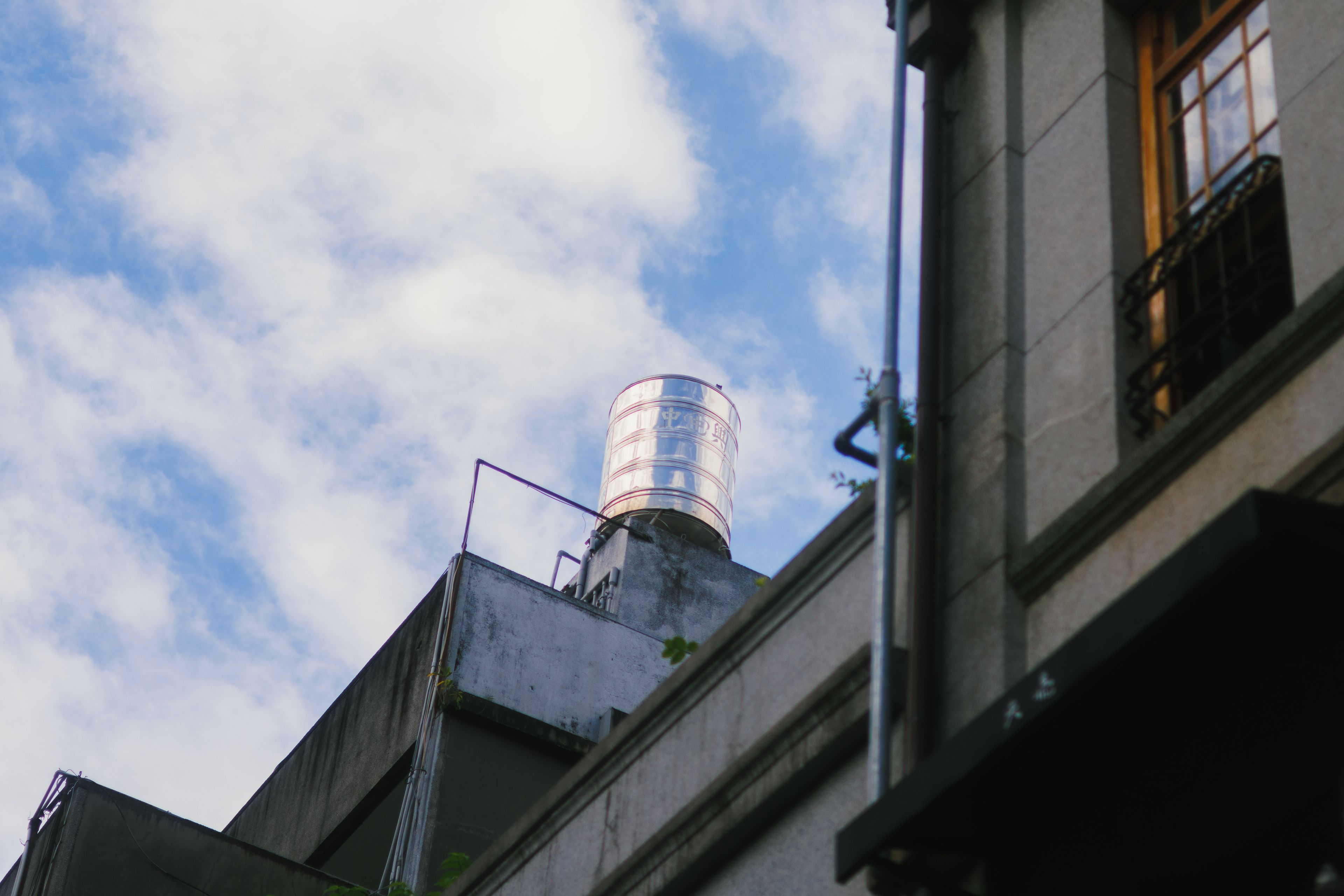
The Saroma villas, the SariTown townhouses and the SOHO row at The Global City are recent multi-storey buildings with a roof terrace. With a tank on the roof, our first question is how we reach it. We work only where there is a fixed ladder, a roof deck with a railing or a solid platform, and near a roof edge the Up specialist, the UpClean staff member who does the work, wears a harness anchored to a load-bearing point. Rain, strong wind or a slippery roof moves the visit to another day.
Building sites are still active around Thu Thiem, Sala and The Global City. In a home just handed over or renovated, cement dust, sand and metal filings fall into the tank or arrive through new pipework, so clean the tank before the family starts using the water. A new cistern should be cleaned and rinsed before its first fill; if it has just been waterproofed, ask your contractor how long to wait.
- Stainless steel
- Sediment sits on the floor and along the weld seams. Soft brushes and pads only: wire brushes, abrasive powder and strong acid cleaners would scratch the steel.
- Plastic
- Walls are scrubbed with soft tools; the lid, its thread and any cracks from ageing are checked and noted for you.
- Underground cisterns
- Mostly concrete, tiled or coated, holding a lot of water behind one small hatch. We take the job where the hatch is wide enough and the space can be ventilated.
On the day: from shutting the valve to water at the tap
Each stage is photographed for your Up Report, the photo report sent by WhatsApp or Zalo after every visit, so you see the tank before and after without climbing onto the roof.
- You store water for the hours without supply; we give you the shut-off time in advance.
- The supply valve is closed, the pump switched off so that it cannot run dry, and the remaining water drained as agreed.
- Sediment is removed; walls, floor, corners and the underside of the lid are scrubbed, and the float, inlet, outlet and any screen cleaned.
- The tank is disinfected with a product approved for domestic water storage, at the manufacturer's dose and never mixed with another.
- It is rinsed with clean water until no smell of the product remains. Only then is the valve reopened and the flow checked at a tap.
- Lid, seal and insect screen are checked, faults recorded, and the roof, yard or pump room left tidy.
- Inside a cistern
- A cistern is a confined space where the air may be short of oxygen or hold gases from decaying sediment. The hatch is opened to ventilate first, and at least two people work together, one staying above throughout. With an unusual smell, poor ventilation, a hatch that is too narrow or water flowing in unchecked, nobody enters and we propose another approach.
What it costs in District 2: prices by capacity, with examples
Prices are all-inclusive per tank and go by capacity: 450,000 VND for a tank up to 1,000 L, 650,000 VND over 1,000 up to 2,000 L, 850,000 VND over 2,000 up to 5,000 L. An underground cistern is charged by volume at 70,000 VND per m³, with a minimum of 1,500,000 VND. Tanks over 5,000 L are quoted after a survey, and no visit costs less than 450,000 VND.
Send photos of the tank and its access and we confirm which price applies; a cistern or an awkward position gets a free survey on site. The written quote states the items, the team size and the expected time, and changes only with your written agreement. The capacities below are illustrations:
- Townhouse, one 1,000 L stainless tank on the roof terrace
- 450,000 VND.
- Villa, two 1,500 L tanks side by side
- 2 × 650,000 VND = 1,300,000 VND, done in one session so the water is off only once.
- Villa, a 3,000 L roof tank and a 10 m³ cistern
- Tank 850,000 VND; cistern 1,500,000 VND (700,000 VND by volume, so the cistern minimum applies). In all: 2,350,000 VND.
- Villa, a 30 m³ cistern
- 30 × 70,000 VND = 2,100,000 VND.
Tenants, landlords and international families
According to a 2020 Tuoi Tre report, almost 6,000 foreigners of 102 nationalities live in Thao Dien, where furnished rental villas are common. The house may have stood shut for weeks between two leases, so before moving into a rented home, or after a long absence, have the standing water drained and the tank cleaned.
- English
- English works throughout: enquiry, quote, booking confirmation and Up Report. Ask when you book if you want an English-speaking specialist on site; when none is free we say so beforehand and help by phone or message instead.
- If you rent
- Tell your landlord before the water is shut off or the cistern hatch opened. The Up Report gives you both the same photographs.
- Gated compounds
- Guards log visitors, so we send your specialist's name, photo and contact number ahead for you to pass on; Up specialists are identity-verified and trained to the Up Standard. On site the guards decide where we park and where outdoor water and power may be used.
- Keys and payment
- Nobody needs to stay in. A key left with the guards, the compound manager or a relative stays with the assigned specialist and is never copied. You pay after checking the work, in person or by video call, by bank transfer or in cash; invoices under Vietnamese regulations are issued on request.
How often to clean, what we do not do, and how to book
A household tank is usually cleaned every six to twelve months; the incoming water, the tank's position and how well the lid seals set the real interval.
- No water testing
- We clean and disinfect the tank. We do not test the water, certify it or commit to any water-quality figure. If you need a test, use an accredited laboratory after the clean.
- No repairs
- Floats, pipe inlets and lids are cleaned and their condition recorded in the Up Report; repair or replacement is a job for a plumber.
- If something falls short
- Reply to the Up Report within 48 hours and any item within the agreed scope is redone free of charge.
- Booking
- Message +84 968 726 135 on WhatsApp or Zalo with photos of the tank and the way up, or of the cistern hatch. If we are more than 15 minutes late, that visit is 10% off; you can change or cancel free of charge up to 24 hours ahead, after which a 30% fee applies.
What does UpClean's water tank cleaning include?
- Survey of tank location, access, capacity and sediment before work starts
- Supply valve closed and remaining water drained as agreed with you
- Sediment removed; walls, floor, corners and underside of the lid scrubbed
- Float valve or float switch, inlet, outlet and screens cleaned
- Disinfection with approved products for domestic water storage, at the labelled dose
- Repeated rinsing with clean water before the supply is restored
- Lid, seal and insect screen checked; any faults recorded (no repairs)
- Up Report with before-and-after photos via Zalo or WhatsApp
Written by the UpClean technical team, reviewed by Trần Nguyễn Hữu Nhật — Founder of UpClean.