
What is my rug made of, and why does that decide how to clean it?
The fibre decides how much water a rug can take, which products are safe and how long it needs to dry. Read the label on the back, then look at the backing and feel the pile, as an Up specialist does first. If there is no label, keep to vacuuming and blotting until close-up photos of the pile and the back have been assessed.
| Rug type | How it reacts to water and cleaning |
|---|---|
| Synthetic: polypropylene, polyester, nylon | Colourfast and tolerates water well; common in bedrooms and children's rooms. A professional clean treats grease marks first, then spray-extracts the whole surface. |
| Wool | Holds water for a long time, and a strong product or hot water can make it shrink or bleed. Very little water, nothing hot. |
| Hand-knotted | Each block of colour may have been dyed differently, so the colour test matters more. A stiff brush or hard scrubbing can fuzz the fibre and distort the knots. |
| Viscose and silk | Glossy fibres that flatten, yellow and lose their sheen easily when wet. Blot a spill; any wet cleaning waits for an assessment from photos. |
| Jute, sisal and seagrass | Plant fibres that shrink and turn brown when wet; they too are assessed from photos before any wet cleaning. |
| Shag and other long pile | Holds dust low down and takes longer to dry; assessed from photos first. |
How should a rug be vacuumed and looked after from week to week?
Routine is enough until the walkway strip darkens, the pile stays flat after vacuuming, or the rug smells damp after several rainy days.
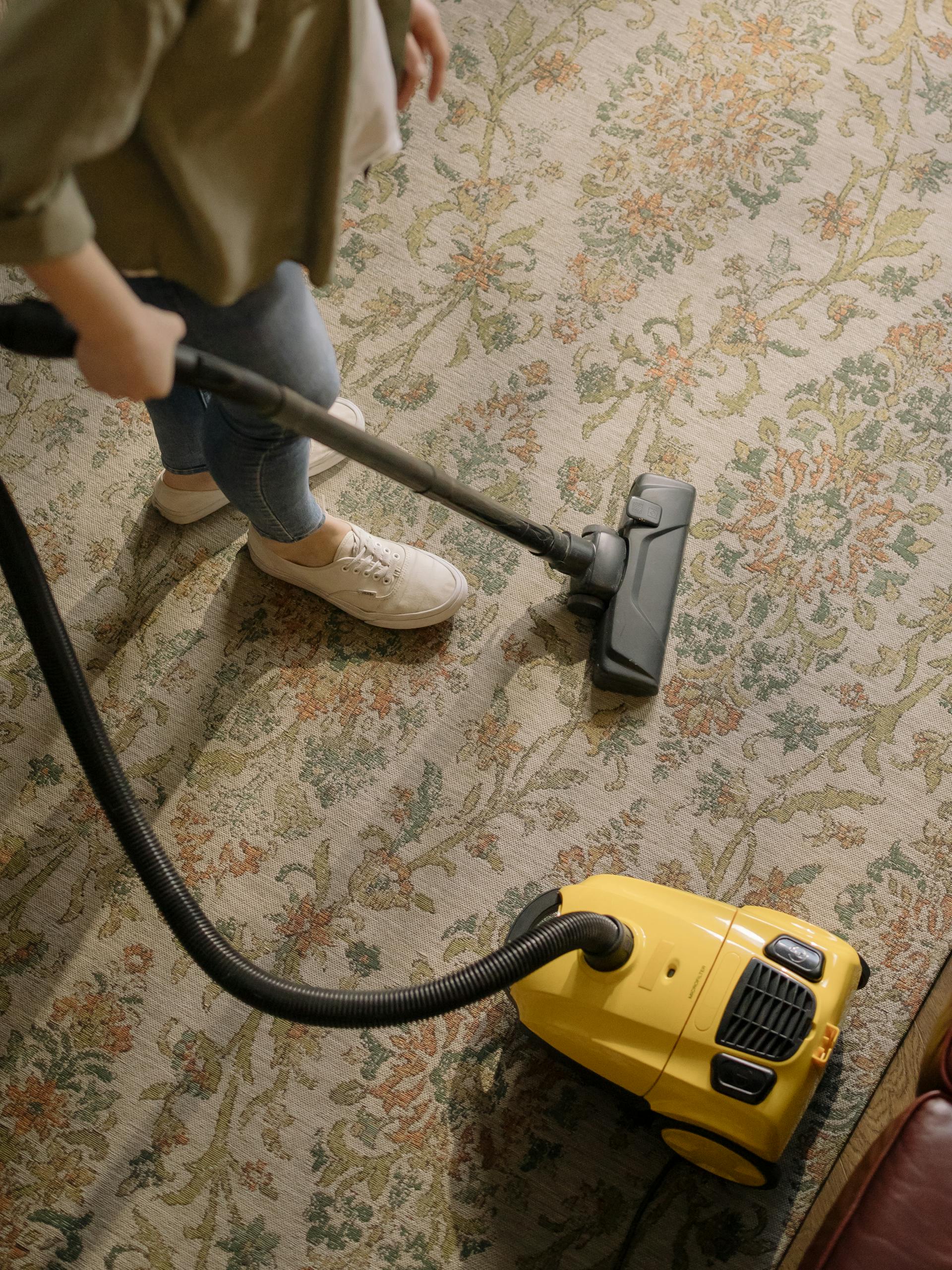
- Vacuum once or twice a week. On wool and hand-knotted rugs, switch off the rotating brush.
- Keep doormats at the front and balcony doors to stop grit coming in.
- With a non-slip underlay, a loose rug shifts less and its backing rubs less on the floor.
- Turn the rug round by 180 degrees each season, so that sunlight and footsteps fall evenly.
- Snip a raised thread on a hand-knotted rug level with scissors; pulling it can loosen a row of knots.
- To store a rug, have it cleaned, then roll it with the pile and wrap it in breathable cloth, not sealed plastic.
How do I get coffee, wine, food or mud out of a rug without spreading it?
Act at once, blot rather than rub, and move from the rim of the mark towards its middle. Use a white cloth, since a damp coloured one can pass on its dye, and keep strong chemicals off wool and hand-knotted rugs.
| Stain | What to do first |
|---|---|
| Coffee, tea, red wine | Blot straight away and do not rub soap in. Fresh spills usually respond well to a professional clean. |
| Mud | Let it dry completely, then vacuum. Wiping it wet drives it into the pile. |
| Grease, cooking oil, lipstick | Lift off what sits on top and press dry kitchen paper onto it. No hot water. |
| Candle wax, chewing gum | Harden it with an ice pack and ease off the raised part. No iron. |
| Nail varnish, ink | Do not try acetone or alcohol, which can damage synthetic fibre and viscose; leave it for the specialist to test. |
| Pet urine, vomit | Blot dry, see below, and mention the spot when booking. |
How do I spot-clean a synthetic rug without leaving a ring?
On fabric, a ring usually comes from soaking one small patch or from soap left in the fibre. The steps below are the method for water-safe upholstery fabric; on a rug, keep them to synthetic pile.
- Test on a hidden corner and let it dry before you judge the colour.
- Dampen a white microfibre cloth and wring it almost dry. Do not pour or spray liquid straight onto the rug.
- Work the cloth evenly over the area around the mark as well as the mark itself, so that no sharp wet edge is left.
- Go over it again with a cloth moistened in plain water: soap left behind attracts dust again.
- Press a dry towel onto it and dry it with a fan; a hot hairdryer held close can scorch synthetic fibre.
How do I treat pet urine and vomit on a rug?
Urine soaks through the pile, often into the backing, so the cleaning solution has to reach as deep as the urine did. The Humane Society for Tacoma & Pierce County, in the United States, says a black light usually reveals old spots and that old or large stains can take several treatments. It warns that a hot steam cleaner or dryer can set stain and smell into synthetic fibre.
Use an enzyme cleaner for organic stains, test it on a hidden corner, leave it as long as its label says, blot and air-dry. Avoid ammonia, which the Cornell Feline Health Center notes smells like urine and can draw a pet back, and chlorine bleach, which fades rugs and must never be mixed with another product.
- Pets at home: odour, fleas and ticks
- Finding old spots with a UV torch, and what baking soda and vinegar can and cannot do.
Can a rug be washed in the shower, on the balcony or in a washing machine?
Hosing a rug down on the balcony or in the bathroom should be avoided: water soaks it through to the backing; indoors it then dries very slowly and tends to smell, and wool can shrink or bleed. A washing machine is only for a rug whose care label allows one, on the programme the label gives.
Spray extraction avoids the soaking: solution is sprayed into the pile and drawn back out almost at once, dirt and all. A valuable hand-knotted rug, or one needing a full immersion wash, is assessed first and you are advised plainly; transport and immersion washing are outside UpClean's per-m² price.
How do I dry a rug in the rainy season without a musty smell?
Quickly. The US Environmental Protection Agency (EPA) recommends drying anything wet within 24–48 hours to prevent mould, and keeping indoor relative humidity below 60%.
- Prop the rug up so that air reaches the back as well as the pile, and set a fan to blow along its surface.
- When it rains, close the windows and run the aircon or its Dry mode (DRY or a water-drop symbol); open them at drier times of day.
- In an unused room, a dehumidifier behind a closed door usually costs less than the aircon.
- Keep heavy furniture off until it is dry; if a table must go back early, plastic pads under the legs stop rust or wood stain marking the pile.
- Never put a wool or hand-knotted rug in strong sun to dry it faster.
- Mould and humidity in Saigon apartments
- Sources of damp, dehumidifiers and hygrometers.
Why does a rug smell damp or show mould, and can that be fixed?
A smell held in the pile usually fades noticeably after a deep vacuum, spray extraction and proper drying. If the backing or the floor beneath has been damp for a long time, the specialist checks it, tells you what was found and suggests how to place the rug to limit a repeat.
Mould is harder: the EPA says porous materials such as carpet are difficult to clean fully once mould has spread into them, and may need replacing. For small surface spots:
- Wear gloves and a mask, since spores can irritate the airways.
- Brush dry mould off outdoors or on the balcony, never in a closed room, then vacuum with a well-filtered machine.
- Keep chlorine bleach away: it fades the rug in patches.
- For a mouldy area larger than roughly a square metre, the EPA advises experienced help.
- Sofa and mattress cleaning in a humid climate
- Deep-clean intervals for soft furnishings in humid weather.
When is professional rug cleaning worth it, and how is it priced per m²?
Every 6–12 months for a rug at home, or every six months with young children, pets or a busy walkway; sooner after a spill, a pet accident or a musty smell, and before storing a rug or moving house.
UpClean charges by area and fibre: 35,000 VND per m² for synthetic, 60,000 VND for wool and 90,000 VND for hand-knotted, all-inclusive, with a minimum of 350,000 VND per visit. Rugs in one visit are added together first, so two wool rugs of 1.6 × 2.3 m (7.36 m²) come to 441,600 VND. Measure both sides and send a photo; the area is confirmed in the quote.
The rate includes the colour test, deep vacuuming, spot treatment, extraction, hand-cleaned fringes and removal of moisture afterwards. A living-room rug takes about 45–90 minutes and dries in 4–8 hours.
| Rug size | All-inclusive price by fibre |
|---|---|
| 1.6 × 2.3 m (3.68 m²) | Synthetic 350,000 VND (visit minimum) · wool 350,000 VND (visit minimum) · hand-knotted 350,000 VND (visit minimum). |
| 2 × 3 m (6 m²) | Synthetic 350,000 VND (visit minimum) · wool 360,000 VND · hand-knotted 540,000 VND. |
| 2.5 × 3.5 m (8.75 m²) | Synthetic 350,000 VND (visit minimum) · wool 525,000 VND · hand-knotted 787,500 VND. |
| 3 × 4 m (12 m²) | Synthetic 420,000 VND · wool 720,000 VND · hand-knotted 1,080,000 VND. |
| Shag, viscose, silk, jute, sisal, seagrass | Accepted only after the specialist has seen photos and explained the risks. |
| Stair and corridor carpet | Photos, measurements and access are reviewed first; a fixed written quote follows. |
What does UpClean's rug cleaning visit involve, and how do I book it?
The rug is cleaned where it lies; fitted carpet stays down. Your Up specialist, identity-verified and trained to the Up Standard, photographs the rug and furniture positions first. Stains soaked into the backing long ago may leave a faint mark or smell; you are told beforehand, and it is noted in the Up Report, the photo record sent by WhatsApp or Zalo after the visit.
You check the result in a walk-through and pay afterwards, by bank transfer or cash. If anything within the agreed scope falls short, reply to the Up Report and it is redone free of charge within the Warranty Policy period, 48 hours by default.
To book, contact 0968 726 135 by phone, WhatsApp or Zalo, any day from 7:00 AM to 8:00 PM, with the rug type, size and a photo. Quotes, confirmations and reports can be in English; if you want a specialist who speaks English, say so, and if we cannot arrange one we tell you in advance. The specialist's name, photo and contact number arrive before the visit, so you can register them with building management if required. A key can be left with reception and the walk-through done by video call.
- Carpet and rug cleaning
- The service in full, with the areas covered.
- Get a quote
- Choose the fibre and enter the area.
- Book a visit
- Pick a day and time; confirmation follows in writing.
- Cleaning service cost in Ho Chi Minh City
- Rug cleaning priced alongside sofas, mattresses, curtains and aircon.
Frequently asked questions
How often should a rug be professionally cleaned?+
Every 6–12 months for a rug at home, or every six months with young children, pets or heavy foot traffic. Vacuum once or twice a week in between.
Is there rug cleaning near me in Thao Dien, Thu Thiem or Phu My Hung?+
Yes. UpClean works regularly in An Khanh (Sala, Thu Thiem, Thao Dien) and Binh Trung in the former District 2, Phu My Hung in the former District 7, Binh Thanh and the city centre. Other districts, such as Go Vap and Tan Binh, are served with the slot confirmed at booking.
Do you use dry carpet cleaning, or take rugs away to be washed?+
Neither. Dry cleaning brushes powder or low-moisture foam into the pile and vacuums it up; it freshens the surface quickly but struggles to lift dirt from the base of the pile. UpClean uses spray extraction on site. A rug needing a full immersion wash is assessed first.
Will cleaning make my wool rug shrink or the colours run?+
That risk comes mainly from too much water or an unsuitable product. The specialist tests colourfastness first, keeps moisture low on wool and hand-knotted rugs and extracts it straight away. If a rug bleeds in the test, you decide before work continues.
Can a viscose, silk or jute rug be cleaned?+
Only after an assessment. Viscose and silk can flatten, yellow and lose their sheen; jute, sisal and seagrass can shrink and turn brown. Send close-up photos of the pile and the back, and the specialist explains the risks before the job is confirmed.
How long does a rug take to dry after a professional clean?+
Usually 4–8 hours, longer for thick pile or a room with still air. Keep the air moving and furniture off until it is fully dry.
How much does it cost to clean one small rug?+
A 2 × 3 m synthetic rug comes to 210,000 VND by area, so the visit minimum of 350,000 VND applies. Because the minimum covers the whole visit, a second rug added to the same booking costs nothing extra while the combined total stays below 350,000 VND.
Related guides
- Polished concrete, polished cement screed or epoxy: which floor suits a house or café in Saigon, and how to maintain each
- How to clean floor tiles and grout: why floors look dull after mopping, and how to lighten dark grout
- Window cleaning in a high-rise apartment: who cleans the outside, what you can safely reach, and how to get streak-free glass
- How to wash pillows and a duvet: what goes in the machine, drying in Saigon's humidity, and when to use a laundry
- How to clean an oven and microwave: burnt-on grease, enamel linings, air fryers and what never to use
- Slippery marble and granite stairs at home: why they get slippery, how to clean them safely, and what polishing can change
- Green or cloudy pool water after rain: what to do, and how to look after a villa pool through Saigon's rainy season
- Mould, damp and musty smells in Saigon apartments: causes and what works
