
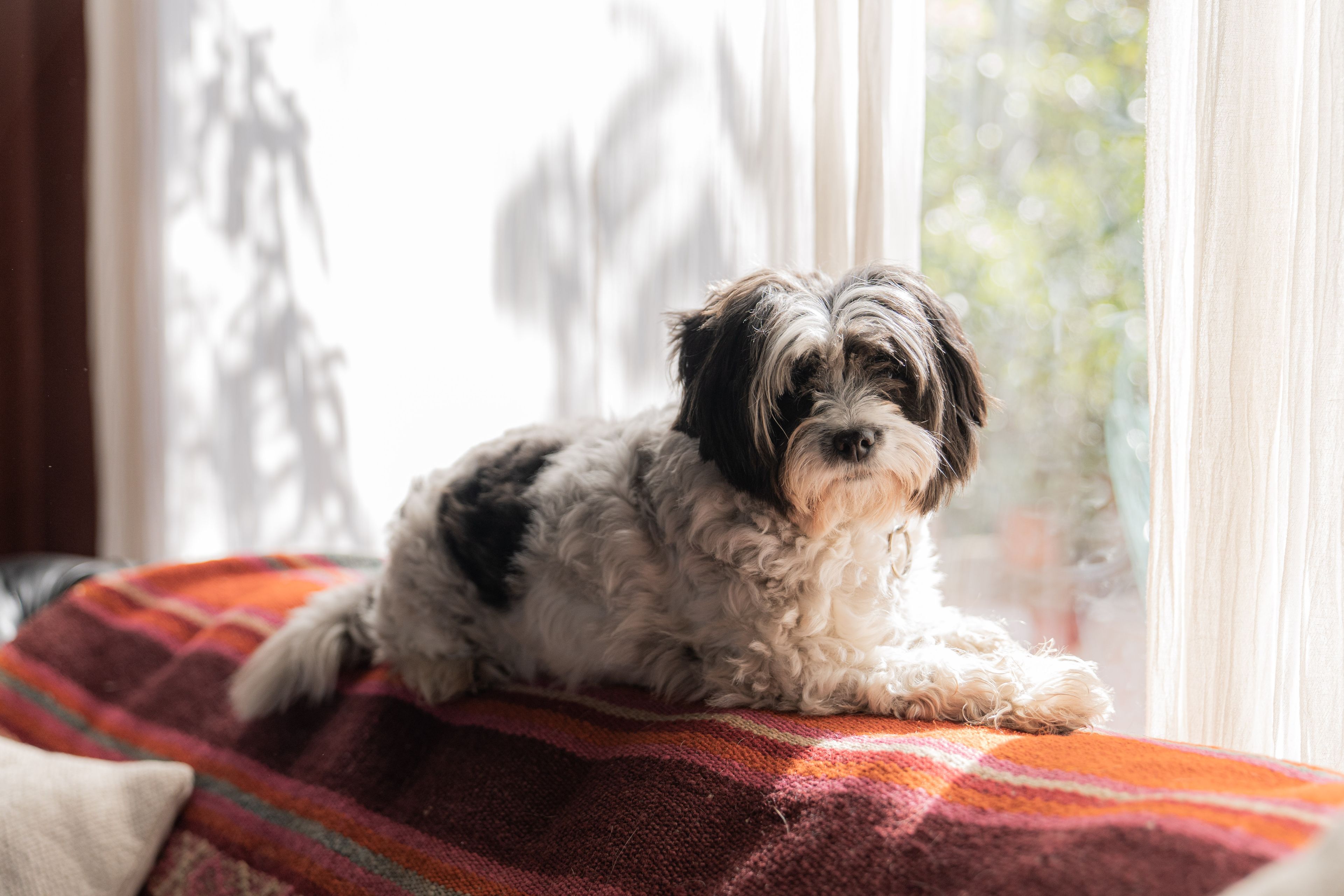
Where does the smell in a home with pets come from?
Work out which kind of smell it is before buying anything; each has its own source and remedy.
| What you smell | Likely source |
|---|---|
| A sharp urine smell | Urine on rugs, sofas, mattresses, floor-length curtains, the base of walls and tile grout. Cat urine is usually stronger and lingers longer than a dog's. |
| A smell around the litter box | Unscooped litter, a tray not washed for some time, litter tracked onto the floor and urine splashed over the side. |
| A doggy smell on fabric | Natural oils from coat and skin on pet beds, blankets and sofa throws, stronger in humid weather. |
| A smell that spreads when the aircon is on | Closed rooms hold odours, and an indoor unit coated with hair and dust can add to them. |
How do I find old pet urine spots?
Dried urine is usually invisible, and the nose registers only a general smell. The Humane Society for Tacoma & Pierce County, in the United States, notes that an ultraviolet black light usually shows up even old urine stains.
- After dark, switch off every light and hold the UV torch close to the floor, rugs, the underside and legs of the sofa, the base of the walls, the sides of the bed and the area around the litter box.
- Outline each glowing patch lightly with chalk or masking tape so that you can treat it with the lights on. Sugary drinks and old cleaning products glow too, so confirm with your nose.
- A cat marking territory usually sprays upright surfaces such as the base of walls, doors and curtains, so look above floor level too.
How do I remove pet urine from a sofa, mattress, rug or floor?
Use an enzyme cleaner made for organic stains and get it as deep as the urine went. That holds for tile grout as much as for fabric.
- Fresh accident: press thick layers of paper towel onto it, changing them until they come away almost dry. Do not rub, which pushes the urine wider and deeper.
- Test the cleaner on a hidden corner first to check the colour of the fabric.
- Spray or pour enough to reach as deep as the urine did, usually the rug backing or the foam. The Humane Society for Tacoma & Pierce County notes that old or large stains can need several treatments.
- Leave it for the time on the label, then blot and let it dry naturally in a ventilated room.
- Keep heat away: the same organisation warns that a hot steam cleaner or dryer can fix the stain and the smell in synthetic fibres.
- Keep the pet off the spot until it is dry.
Enzyme cleaner, vinegar, baking soda or bleach: which should I use?
Use the enzyme cleaner. The Cornell Feline Health Center stresses that the odour has to be neutralised, not just deodorised, because a cat's sense of smell is far keener than ours, and advises against products containing ammonia or vinegar, which smell like urine and can irritate.
Use one product per stain; to change product, wipe with clean water and let the spot dry first. The Washington State Department of Health warns that chlorine bleach mixed with ammonia releases toxic chloramine gas, and advises against mixing bleach with ammonia, acids or other cleaners. Air the room, and keep the pet elsewhere until surfaces are dry.
| Product | What to expect |
|---|---|
| Enzyme cleaner for organic stains | What animal-welfare organisations recommend for urine and vomit. Allow the full contact time on the label. |
| Vinegar | Has a smell of its own that can draw the pet back. Do not use it on natural stone such as marble. |
| Baking soda | Absorbs light odours when sprinkled on a dry rug and vacuumed off. It does not break down urine that has soaked in. |
| Chlorine bleach | Fades fabric and rugs. Never mix it with anything else. |
| Fragranced spray | Covers the smell for a few hours. Use it last, if at all: over untreated urine the smell returns, mixed with the fragrance. |
How do I stop the litter box, pet bed and feeding corner from smelling?
Most of the smell in a home with cats starts at the litter box. The Cornell Feline Health Center recommends one box per cat plus one more. With clumping litter, scoop every day and top up with clean litter; to wash the tray, scrub it with a mild detergent, dry it and refill.
- Put the box somewhere airy but quiet, with a mat to catch litter, and wipe the floor and the base of the walls around it often.
- Bag used litter and take it out every day; do not leave it in the bathroom bin.
- Wash pet-bed liners and blankets weekly and dry them thoroughly.
- Wash bowls daily and wipe the floor around them: spilt wet food smells quickly.
- Air the home in the morning and run the extractor fan in a bathroom that holds the litter box.
Ticks and fleas: why does treating the pet not clear the house?
A tick is an arachnid: the adult has eight legs, is flat when unfed and round like a bean after feeding, and stays attached to the skin for days. The kind most often found in homes with dogs is the brown dog tick; the US Centers for Disease Control and Prevention (CDC) names dogs as its main host at every stage. Fleas are small jumping insects that live in the coat, while their eggs drop onto floors, rugs and pet bedding.
According to the Western College of Veterinary Medicine at the University of Saskatchewan, the brown dog tick can complete its whole life cycle indoors. Larva, nymph and adult each feed on the dog for a few days, then drop off to moult, and a fed female lays her eggs in crevices where the dog spends time: several thousand of them, according to Texas A&M University's extension service. The college gives the survival times below and concludes that ticks on the dog and ticks in the building must be controlled together.
| Stage of the brown dog tick | Survival without a blood meal |
|---|---|
| Larva | About 253 days. |
| Nymph | About 97 days. |
| Adult | Up to 568 days. |
What does the vet decide, and what should I not do to the animal?
Which tick or flea product suits your animal depends on its weight, age, breed and health, whether it is pregnant or on other medication, and whether there is a cat in the home. Identifying the parasite and choosing the treatment are for the vet, and the product is used as the vet prescribes, at the stated dose and interval.
The Cornell Feline Health Center warns that some products that are safe for dogs can poison cats, even when a cat licks the coat of a newly treated dog. Treat a cat only with products made for cats, on a vet's advice.
- Do not combine tick products, or raise the dose because ticks are still appearing.
- Do not spray household insecticide on a dog, a cat or their bedding.
- Read the label, keep the product away from children, watch how the animal reacts, and see the vet early if anything seems wrong.
How do I clear ticks and fleas from the home, and when do I need a professional?
The University of Rhode Island's TickEncounter programme describes an established infestation as ticks of every size crawling up walls and curtains. Consider professional treatment at that point, or when new ticks keep appearing although the dog has completed its course, when they are in several rooms, or when there are young children or older people at home. Insecticide treatment of a home is for a provider eligible to carry it out, using products validly registered in Vietnam, with guidance on how long people and pets stay out.
The cleaning is yours to do either way, and thorough vacuuming also takes up some flea eggs and larvae:
- Vacuum floors, rugs, sofas, under furniture, floor gaps, grout lines, skirting and cornices; the University of Rhode Island advises vacuuming cracks in walls too. According to Texas A&M, regular vacuuming removes a considerable number of ticks from carpet.
- After each pass, seal the vacuum bag or the contents of the canister in a plastic bag and put it in an outside bin, so that live ticks and eggs cannot crawl back.
- Wash the dog's blankets and bed liners at the highest temperature the care label allows and dry them thoroughly. Replace a heavily infested bed.
- Cut the grass, clear leaves and check the dog after every outing: between the toes, in the ears, on the neck and in the armpits.
What does it cost to have pet odour treated?
There is no separate pet rate. Each item is charged at UpClean's listed, all-inclusive price for that service, subject to its minimum, and the quote is confirmed in writing before the visit.
| Item | Listed price |
|---|---|
| Sofa odour treatment, three seats | 300,000 VND (80,000 VND per seat, minimum 300,000 VND). |
| Fabric sofa clean, three seats | 390,000 VND (130,000 VND per seat, minimum 390,000 VND). |
| Queen mattress (1.6 m) with dust-mite treatment | 550,000 VND. |
| Rug, 2 × 3 m | Synthetic 350,000 VND, wool 360,000 VND (minimum 350,000 VND per visit). |
| Regular hourly cleaning (Up Home) | 130,000 VND per hour, minimum 3 hours per visit. |
| Pet odour in several rooms | Quoted after a survey at home or from photos and video. |
| Ticks and fleas in the home | No listed price. A written, all-inclusive quote follows a free survey. |
What UpClean does in a home with pets, and how to book
UpClean's pet-friendly home cleaning puts listed services in a workable order: hair is vacuumed from fabrics, urine spots are found and treated at the source with a product for organic stains, then sofas, mattresses, rugs and curtains are cleaned. Fresh stains usually respond well; an old stain deep in the foam may be much reduced without disappearing, and the Up specialist, an identity-verified and trained UpClean cleaner, tests first and tells you what to expect. Pets stay in a closed room with water, or with a family member. UpClean does not groom, bathe, board or treat animals.
Ticks and fleas are a separate service: UpClean's own pest-control technicians treat the hiding places in the home, Up specialists vacuum and clean soft furnishings in the order the plan sets, and the animal remains the vet's patient. UpClean has declared its eligibility to provide pest-control services as required by regulation; the declaration and product information are available on request.
To book, call or message 0968 726 135 (phone, WhatsApp or Zalo) between 7:00 AM and 8:00 PM, any day, and say which animals you have and where the stains are. Quotes, confirmations and the Up Report, the photo record sent after each visit, can be in English. You receive the specialist's name and photo in advance, which is what an apartment building needs if it asks residents to register outside staff.
- Pet-friendly home cleaning
- What the service includes and the areas covered.
- Sofa and mattress cleaning in a humid climate
- Drying a cushion or mattress after spot cleaning.
- Mould and humidity in Saigon apartments
- Bringing indoor humidity down.
- Get a quote or book
- Price the sofa, mattress and rugs online.
Frequently asked questions
Does cat urine smell go away on its own?+
Usually not. Urine that has soaked into fabric, foam or tile grout keeps giving off odour, most of all in humid weather. Find the spot and treat it with a cleaner made for organic stains.
Why does my cat keep peeing in the same spot after I have cleaned it?+
Either some odour remains below what a person can smell, or the cause is the cat's health or its litter box. Treat the spot again with an enzyme cleaner, and see a vet: the Cornell Feline Health Center advises an examination, because the cause may be medical and not just habit.
I treated my dog for ticks. Why are there still ticks in the house?+
Because most eggs, larvae and nymphs are in the home, not on the dog. The brown dog tick can complete its life cycle indoors and live for months without feeding, so crevices and bedding have to be dealt with alongside the dog's own treatment.
Can I use my dog's tick or flea product on my cat?+
No. The Cornell Feline Health Center warns that some products that are safe for dogs can poison cats. Use only products made for cats, on a vet's advice.
Do dog ticks bite people, and are they dangerous?+
They can bite people. The CDC records the brown dog tick as a carrier of Rocky Mountain spotted fever in the south-western United States and along the US–Mexico border. If one attaches to you, remove it properly, wash the skin, and see a doctor if you develop a fever or a rash.
How do I remove a tick from my dog?+
Texas A&M's extension service advises blunt-tipped tweezers: grip the tick close to its mouthparts and pull gently and steadily. Do not crush it with bare fingers, and wash your hands and the skin afterwards.
Related guides
- Why does my washing machine smell? How to clean it yourself, and when the drum has to come out
- How to clean a fabric sofa at home: the care label, stains by type, mould spots and when to book a deep clean
- Leather sofa cleaning and care: which leather you have, which cleaner to use and what never to put on it
- How to clean a mattress and topper at home: stains, odour, drying, and what to do with latex and memory foam
- How to clean curtains and blinds by type: what can go in the washing machine, how often, and how professional cleaning is priced
- Washing machine not spinning, not draining or draining all the time: causes and what to check
- Front-loader or top-loader washing machine: the practical differences, how each is cleaned, and what that costs
- How to clean a fridge and range hood: smells, door seals, the drain hole, grease filters and what a professional clean costs
