
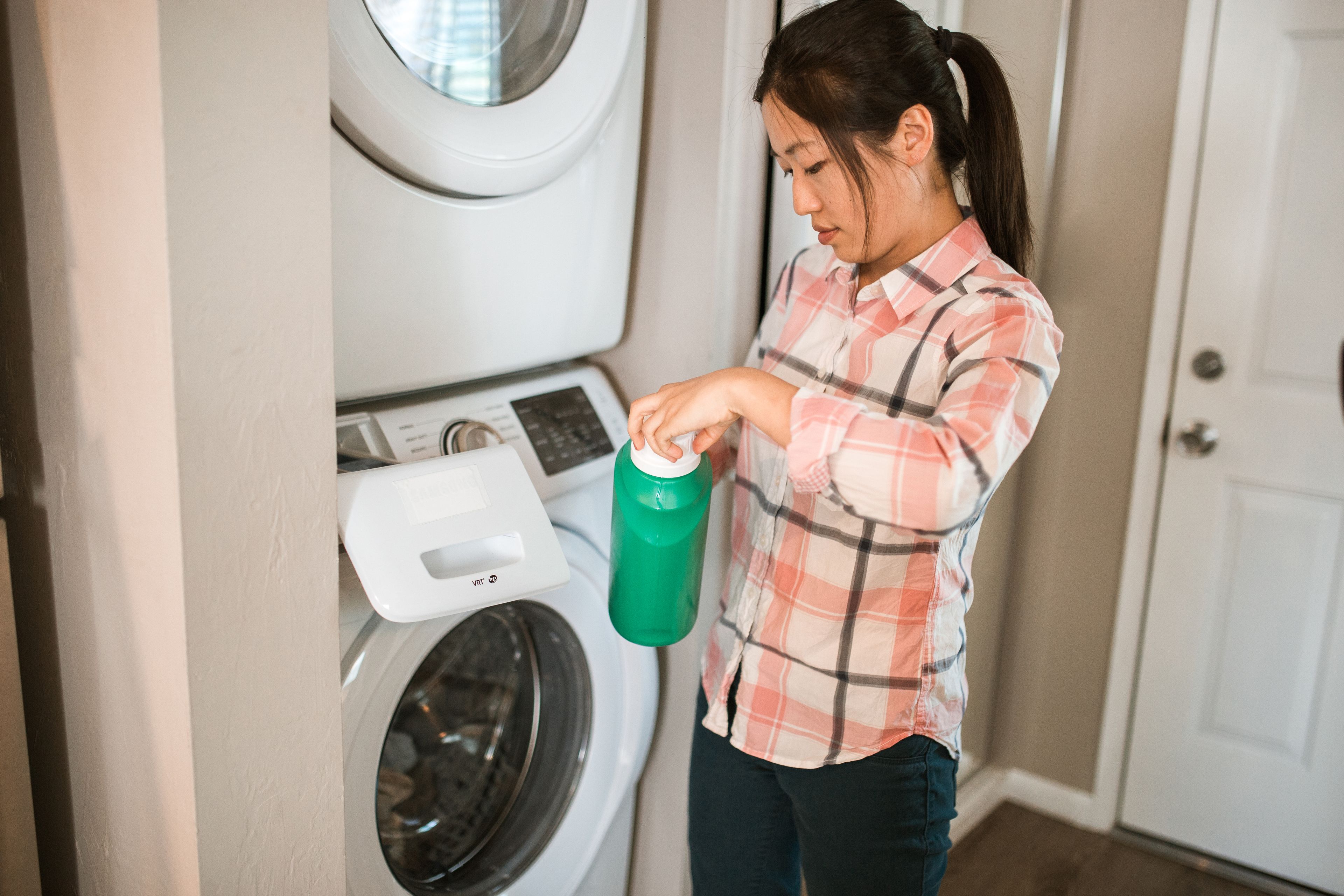
What are the practical differences between a front-loader and a top-loader?
These are the points that matter when you furnish a flat or take over the machine that came with one. On shop labels in Vietnam a front-loader is “cửa ngang” and a top-loader “cửa trên” or “cửa đứng”.
| Point | Front-loader and top-loader |
|---|---|
| How it washes | Front-loader: the drum lies on its side, lifting the laundry and dropping it through a small amount of water. Top-loader: the drum stands upright, and a pulsator (a wash plate at the bottom) or a central agitator turns the laundry in a large amount of water. |
| Electricity and water | The front-loader usually needs less of both and spins the laundry drier. The top-loader takes more water per load, though recent models have improved a good deal. |
| Space | Front-loader: room in front for the door. Top-loader: room above for the lid. |
| Loading | Front-loader: you bend, and the door is locked during the wash. Top-loader: you stand, and many models accept an extra item part-way through. |
| Upkeep | Front-loader: door seal, detergent drawer and drain pump filter. Top-loader: lint filter bag, drum rim and lid. |
| A clean with the drum removed, at UpClean | 450,000 VND for a top-loader up to 9 kg; 690,000 VND for a front-loader up to 9 kg. |
Which type washes cleaner and is gentler on clothes?
The front-loader, by a margin that is smaller in Vietnam than the usual comparison suggests. ENERGY STAR, the efficiency programme of the US Environmental Protection Agency, states that front-loaders clean better and treat clothes more gently, so that items washed often last longer, while top-loaders with an agitator can wear fabric sooner. Most top-loaders sold in Vietnam have a low pulsator and no agitator, which narrows the gap; what remains also depends on the programme, the size of the load and the detergent.
Hot water is the other difference. Many front-loaders have a heater and can wash hot, which helps with greasy stains, baby clothes and towels. Most ordinary top-loaders wash at the temperature of the water supply, and only some premium models add a hot wash.
Does a front-loader use less water and electricity?
Usually, yes. ENERGY STAR reports that front-loaders carrying its certification use about 45% less energy and 50% less water than agitator top-loaders, and are about 25% more efficient than top-loaders with a pulsator. Front-loaders also spin faster, so the laundry comes out drier and needs less time on the line or in the dryer.
Those figures describe machines certified for the US market and should be read as a general tendency. When you compare models in a shop in Vietnam, go by the energy label and the stated water consumption of that particular model. One caution: a hot wash on a front-loader takes a considerable amount of electricity to heat the water, so keep it for the loads that need it.
Which fits a small flat, and which is easier to use every day?
Measure the space first, because the two types need their clearance in different places. In an apartment the machine usually stands on a service balcony or in a small laundry room.
- A front-loader opens at the front. It can be built in under a kitchen worktop or into a cabinet recess, or carry a dryer to save floor space. Leave room in front of it to open the door and to reach the filter.
- A top-loader opens upwards. It cannot go under a low worktop and nothing can be stacked on it; in return it needs only enough space in front for you to stand.
- A front-loader spins fast, so it needs a flat, solid floor and carefully levelled feet to limit vibration.
- Around a built-in machine, leave a gap for ventilation and for pulling the machine out when it needs maintenance.
| Type | Daily use |
|---|---|
| Top-loader | Loading upright suits older people, and the cycles are usually shorter. |
| Front-loader | You bend or crouch, unless the machine stands on a raised plinth. Some models have a small second door for adding items. The cycles are usually longer and wash more thoroughly. |
Which type is more prone to mould and residue?
Both types build up residue in the gap between the inner drum and the outer tub, out of sight. They differ in the places that need attention from week to week, and the front-loader asks for more of it.
| Type | Where residue and mould collect |
|---|---|
| Front-loader | The rubber seal round the door keeps water and lint after each load and develops mould spots if it is not wiped, and the detergent drawer cakes with residue. The door and the drawer have to be left ajar so that the machine dries, and the drain pump filter needs cleaning at intervals. |
| Top-loader | Softener residue settles on the rim of the drum and under the lid, and the lint filter bag fills up. The heaviest deposits sit under the pulsator, on the outer face of the drum and on the floor of the outer tub, and come away as black flecks on the laundry. |
| Routine care for either type | The tub-clean programme and the weekly routine, step by step. |
Which should I choose?
The choice comes down to the space you have, the way you wash and how much care you are willing to give the machine.
| Choose | When |
|---|---|
| A front-loader | The balcony is narrow and you need a stacked dryer or a built-in machine; you wash a lot of thin fabrics or loads that need hot water; saving water and drier laundry come first; you are willing to wipe the door seal after each wash. |
| A top-loader | Someone in the home is elderly or finds bending difficult; you often add items part-way through; you want short cycles and simple operation and cleaning; the budget for the machine is tighter. |
What should I check on a machine that came with a rented flat?
Have it cleaned before your first wash if the machine came with the apartment or has stood unused for several weeks; a landlord can equally have it done before handing the flat to a new tenant. Residue sits where it cannot be seen, so the signs usually show on the laundry before they show in the drum.
- Tiny black or brown flecks on pale clothes, towels and bed linen.
- A damp or sour smell on laundry that has just been washed.
- On a front-loader, dark spots, slime or standing water in the lower fold of the door seal.
- A detergent drawer caked with residue, or softener still sitting in it after the cycle.
- Water that drains more slowly than it used to; the drain filter may be clogged.
How is each type cleaned with the drum removed?
The thickest deposits lie between the two drums, and the only way to reach them is to take the inner drum out. UpClean does this as standard, in the home. The specialist runs the machine, protects the floor and walls and photographs the machine before opening it, marks the parts as they come off, and afterwards reassembles everything and runs a test cycle with you.
A clean without removing the drum reaches the visible drum surface, the seal, the drawer and the filter. It suits a machine that is new or carries little residue, and upkeep between two services, but the hidden faces are hard to inspect afterwards.
| Type | What comes apart and what is cleaned |
|---|---|
| Top-loader | The casing and the pulsator come off and the inner drum is lifted out of the outer tub. Cleaned: the inner drum, the outer tub and its floor, the pulsator, the shaft, the lid, the detergent compartment, the drain filter and the drain line. |
| Front-loader | The casing comes off and the inner drum is separated from the outer tub by the procedure for that model, which means removing more parts. Cleaned: the outer face of the inner drum, the inner face of the outer tub, the shaft, the door seal, the detergent and softener drawer, the drain filter and the drain line. |
| Washer-dryer | The drying system sits inside the body of the machine, so more has to be dismantled. |
How long does the clean take, and what does it cost?
Each price is fixed for one machine and covers removing the drum, cleaning, reassembly, a test run and the Up Report, a record of the visit with photos of the drum before and after. Capacity is read from the rating label on the machine, and the price is confirmed in writing before you book. A front-loader costs more than a top-loader of the same capacity because more parts come off and the work takes longer.
The times are a guide; a machine that has gone a long while without cleaning can take longer. If you are still deciding between the two types, count periodic cleaning as part of the cost of owning the machine, next to the purchase price and the water and electricity bills.
| Type | Time and fixed price |
|---|---|
| Top-loader | About 1.5–2 hours. 450,000 VND up to 9 kg; 550,000 VND above 9 kg. |
| Front-loader | About 2–3 hours. 690,000 VND up to 9 kg; 790,000 VND above 9 kg. |
| Washer-dryer | The price for its door type and capacity plus 150,000 VND. |
| Two machines in one home | Each at its own price. A top-loader and a front-loader, both above 9 kg, come to 1,340,000 VND. |
| Japanese-market, commercial or hard-to-reach built-in machines | Quoted after a free survey from photos. |
What UpClean does on the visit, and how to book
Send the door type, the capacity and whether the machine also dries, and UpClean replies with the fixed price in writing. Four photos help the specialist identify the model and bring the right tools: the whole machine, the rating label, the inside of the drum (with the fold of the door seal on a front-loader) and the way into the laundry area. Before the visit, empty the drum and clear whatever stands on or around the machine; it does not have to be moved or taken out of its cabinet beforehand.
UpClean cleans and does not repair or replace parts. A noisy bearing, a leak or an operating fault is noted in the Up Report so that you can contact a repair service. If the drum still smells or carries residue afterwards, say so within 48 hours of receiving the Up Report and that item is redone free of charge. You pay after the walk-through, by bank transfer or cash.
Bookings are taken on 0968 726 135 by phone, WhatsApp or Zalo, from 7:00 AM to 8:00 PM every day, and the quote, the confirmation and the Up Report can be in English. Up specialists are identity-verified and trained to the Up Standard. You are sent your specialist's name and photo before the visit; many apartment buildings ask residents to register outside staff with building management in advance, and those are the details they want.
- Washing machine cleaning
- Scope for each type of machine and the areas served.
- Get a quote
- Choose the door type, the capacity and any washer-dryer.
- Book a visit
- Request a day and a time slot online.
Frequently asked questions
Does a top-loader need cleaning as well?+
Yes. Detergent residue and deposits build up under the pulsator and on the outer face of the drum, and break off as black flecks on clothes. Run the tub-clean programme monthly, and have the drum taken out and cleaned about every six months if the machine is used every day.
Can I stack a dryer on a top-loading washing machine?+
No. The lid opens upwards, so nothing can stand on the machine. Put the dryer beside it, or choose a front-loader and stack the dryer with the manufacturer's stacking kit.
Can I add clothes to a front-loader once the wash has started?+
It depends on the model. The door is locked throughout the cycle; some machines let you pause and open it while the water level is still low, and some have a small second door for the purpose. Top-loaders are usually more flexible here.
Does taking the drum out harm the washing machine?+
The specialist runs the machine and records its condition before opening it, marks the parts, reassembles them by the correct procedure and runs the machine again with you. For a machine still under warranty, check the manufacturer's warranty terms before you book.
Can a machine with a one-piece outer tub be cleaned?+
Some models have an outer tub made in one piece and need a different approach. Send photos of the machine and its rating label, and UpClean tells you what can be cleaned before you book.
How much does it cost to clean a washer-dryer?+
Add 150,000 VND to the price for the door type and capacity: 840,000 VND for a front-loading washer-dryer up to 9 kg and 940,000 VND above 9 kg.
Related guides
- How to clean a fridge and range hood: smells, door seals, the drain hole, grease filters and what a professional clean costs
- How to remove limescale and yellow stains in a bathroom: shower glass, toilet, tiles, grout and taps
- Bad smells at home and in the bathroom: how to find the source and get rid of it
- After a renovation: how to get rid of paint smell safely and remove cement and paint stains from tiles
- How to clean granite, marble and quartz kitchen worktops, and remove oil, wine and rust stains
- Mould, damp and musty smells in Saigon apartments: causes and what works
- Sofa and mattress cleaning in a humid climate: how often, what you can do yourself, what it costs
- Pets at home in Saigon: how to remove urine odour and deal with fleas and ticks
