
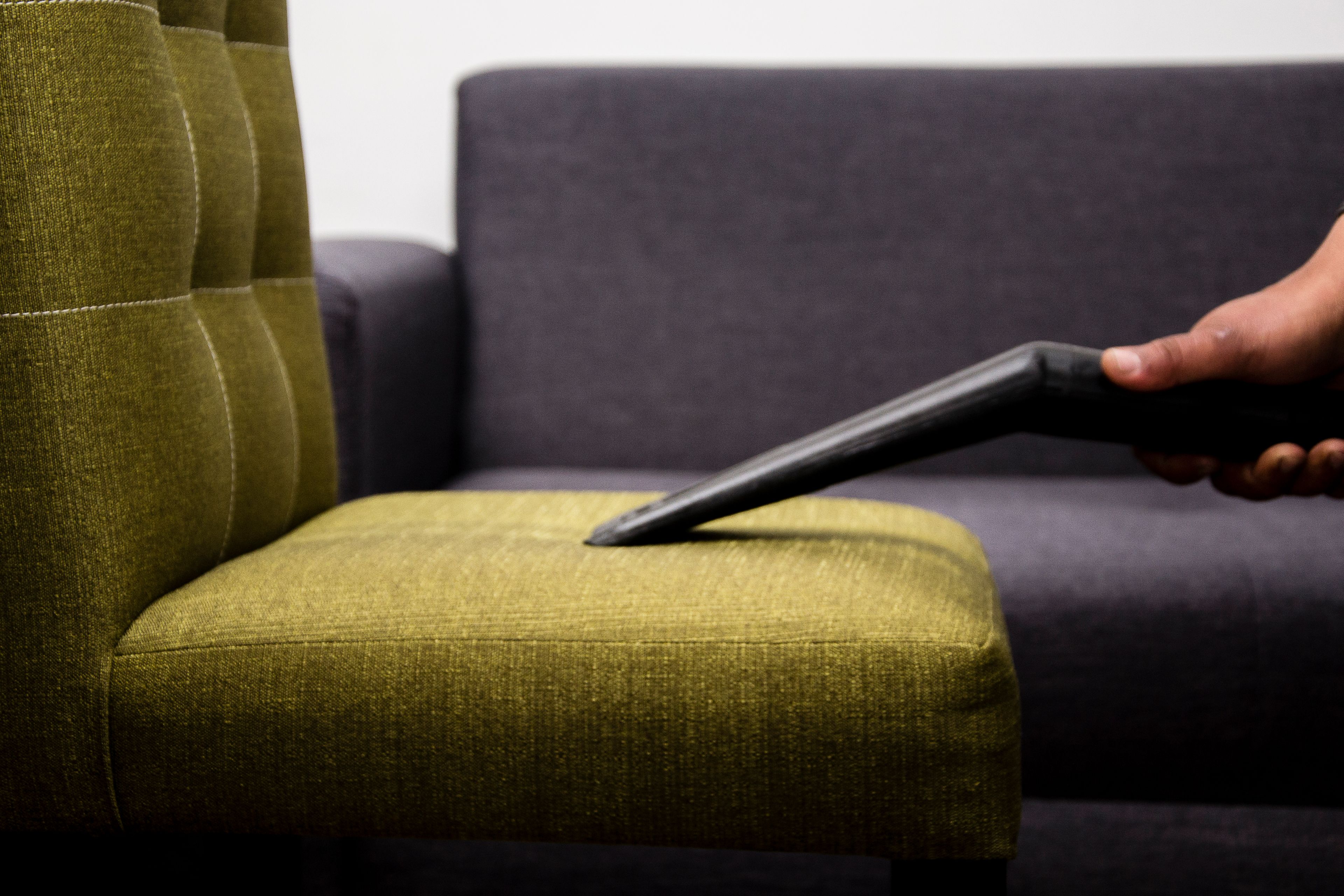
What is the best way to clean a fabric couch at home?
Work dry first, then use as little water as the job allows, and only on a fabric whose label permits it. You need a vacuum with a soft brush head, a few white microfibre cloths, colourless washing-up liquid and a fan.
- Take off the back cushions and loose seat cushions and vacuum every face. Go slowly along the gaps between arms and seats, where crumbs and pet hair collect.
- Brush the fabric lightly in one direction to lift the fibres, so that fine dust comes loose before anything gets wet.
- Mix a solution that suits the code on the label (next section). For a W fabric, use about a teaspoon of colourless washing-up liquid in a litre of warm water.
- Dab a little onto a hidden corner with a white cloth, let it dry and check that the colour is unchanged.
- Dip a white microfibre cloth, wring it until nearly dry and wipe one small area at a time, always in the same direction. Never pour or spray a large amount straight onto the sofa.
- Go over the area with a cloth dampened in clean water only. Soap left in the fabric attracts dust.
- Blot with a dry cloth, switch on the fan or open the windows, and stand loose cushions on edge so that both faces get air. Sit on the sofa only when it is completely dry.
What do W, S, W/S and X on a sofa care label mean?
They tell you which kind of cleaner the fabric tolerates. Look for a sewn-in label beneath the seat cushions or under the frame. Cleaning against the code is a frequent cause of colour bleeding, shrinkage and ring-shaped marks.
| Code on the label | What you may use |
|---|---|
| W (water) | Water-based cleaners, such as water with a few drops of mild washing-up liquid. This is the easiest fabric to look after. |
| S (solvent) | A dedicated dry-cleaning solvent, and no water. Water can leave marks that are hard to treat. |
| W/S | Either a water-based cleaner or a solvent. Test on a hidden corner all the same. |
| X | A vacuum and a light brush, nothing more. Any liquid may damage the fabric, so further cleaning is a job for a specialist. |
| No label left | Assume the fabric is sensitive. Put a very small amount of clean water on the back of a cushion, let it dry fully and check the result before going further. |
How do I get a stain out of a fabric sofa?
The sooner you act, the easier it is. Blot, never rub, and work from the outer edge of the mark towards its centre so that it does not spread. These methods are for W and W/S fabrics, after a test on a hidden corner.
| Stain | What to do |
|---|---|
| Coffee, tea, soft drinks | Blot at once with a dry cloth, then dab with diluted washing-up liquid. For an old mark, a little diluted white vinegar can be added. |
| Grease, lipstick | Cover the mark with baking soda or cornflour to draw out the oil, leave it for 15–20 minutes and vacuum it off. Treat what remains with diluted washing-up liquid. |
| Ballpoint ink | Dab lightly with isopropyl alcohol on a cotton bud, changing the bud often. Alcohol can strip some dyes, so stop if the hidden-corner test shows any change. |
| Pet urine, milk, vomit | Blot as dry as you can, then apply an enzyme cleaner for organic stains, which breaks down the source of the smell. Use no hot water on milk; heat can set it. Liquid that has reached the foam needs a deep clean. |
| Chewing gum, candle wax | Hold an ice pack against it until it hardens, then ease it off with a plastic card. Treat the thin film of wax left behind as you would grease. |
How do I remove mould spots from a fabric sofa?
Treat small spots on the surface yourself, and nothing beyond that. A fabric sofa in a poorly ventilated room, against a damp wall, or left wet after a spill readily develops mould spots in the rainy season.
The US Environmental Protection Agency (EPA) says in its mould guidance that porous materials such as carpet and upholstery may have to be discarded once mouldy, because mould grows deep into them and is hard to remove completely. It also recommends drying anything wet within 24–48 hours.
- Move the sofa or its loose cushions somewhere airy and wear a mask and gloves: mould spores can irritate the airways.
- Brush the dry mould off outdoors, then vacuum with a machine that has a good filter. Never brush mould in a closed room.
- Wipe the spots with a damp cloth and diluted washing-up liquid or diluted white vinegar, if the code allows water and the hidden-corner test showed no change.
- Let it dry in moving air. A short spell of gentle morning sun is fine; long, strong sun fades the fabric.
- Keep chlorine bleach off coloured fabric. It can take the colour out in patches and rot the fibres.
- If the spots return within days, the smell comes from inside the cushion or a dark stain keeps spreading, the mould is in the foam. Have a specialist assess it, deep clean it and dry it with professional equipment.
What ruins a fabric sofa when you clean it yourself?
Five mistakes account for most of the damage.
| Mistake | What happens |
|---|---|
| Too much water | It sinks into the foam, which dries slowly. A damp smell and yellowish marks follow, and mould finds the conditions it needs. |
| Scrubbing with a stiff brush | The surface goes fuzzy, sheds pile and ends up a different shade from the fabric around it. |
| A coloured cloth | Once damp, it can bleed dye into the upholstery. |
| Machine-washing cushion covers when the maker does not advise it | The cover can shrink and no longer fit the cushion. |
| A hairdryer on high heat, held close | It can scorch synthetic fibres or leave a stiff patch. |
How do I use cleaning products on a sofa safely?
- Never mix cleaning products. Chlorine bleach with vinegar, an acidic cleaner or anything containing ammonia can release toxic gas.
- Alcohol and dry-cleaning solvents are flammable. Use small amounts with the windows open, away from a gas hob, candles and cigarettes.
- Unplug anything electrical beside the area you are wetting, such as a floor lamp or a charger.
- Keep small children and pets off the sofa until it is dry and no chemical smell is left.
How do I keep a fabric sofa clean for longer?
- Vacuum it every week, above all with pets or small children at home.
- Turn and rotate the seat cushions from time to time so that they wear evenly and hold their shape.
- Stand the sofa a few centimetres from the wall so that air can move behind it. Avoid a damp wall and the spot under an aircon that drips.
- Put a throw where a pet likes to lie and wash it often.
- In the rainy season, watch the humidity in the room and run a dehumidifier when needed.
- Sofa and mattress cleaning in a humid climate
- Deep-clean intervals by household, and why humidity changes them.
When should I book a deep clean, and what will it remove?
Book one when the label says S or X, when a stain has soaked into the foam, when mould keeps returning, or when a smell remains after cleaning. A quick test for the routine case: rub a barely damp white cloth along an armrest or headrest. If it turns grey, enough dust and skin oil have built up for a deep clean to make a visible difference. Do not try this on velvet.
The work is done with a spray-extraction machine, which pushes cleaning solution into the weave and sucks it out again at once, taking the dirt with it while the foam underneath stays dry.
| Problem | Usual result |
|---|---|
| Coffee, tea, soft drinks | A fresh mark usually goes entirely. An old one with a brown edge takes several rounds of spot treatment. |
| Sweat and skin oil on arms and headrests | The darkened areas become considerably lighter. |
| Ballpoint and felt-tip ink | It depends on the ink and the fabric. The specialist tests first. |
| Pet urine | A recent accident responds well. Urine that went into the foam long ago may leave a faint smell. |
| Fabric bleached by the sun or by earlier cleaning | Cleaning does not bring the original colour back. The specialist points these places out before starting. |
What does a deep clean for a fabric sofa cost?
UpClean's listed price for fabric and microfibre is 130,000 VND per seat, plus 50,000 VND for each ottoman or loose cushion, with a minimum of 390,000 VND per visit, reached at 3 seats. Everything cleaned in the same visit is added together before the minimum is checked. The price is all-inclusive and confirmed before you book. A three-seater takes about 60–90 minutes and is usually dry 4–6 hours later in a ventilated room, or with the aircon or a fan running.
| Sofa | Price |
|---|---|
| Armchair, 1 seat | 130,000 VND by the seat, so the visit minimum of 390,000 VND applies. |
| Two-seater | 260,000 VND by the seat, so the visit minimum of 390,000 VND applies. |
| Three-seater | 390,000 VND. |
| L-shaped sofa, 5 seats, with 1 ottoman | 700,000 VND. |
| Living-room set, 3 + 2 + 1 | 780,000 VND. |
| Velvet | Send a close-up of the fabric and the care label first. The job is accepted only once the material is clear. |
What UpClean does on the visit, and how to book
The sofa is cleaned where it stands: the frame is not taken apart and nothing leaves your home. The Up specialist, an identity-verified cleaner trained to the Up Standard, checks the fabric, stitching and care label, tests colourfastness on a hidden spot and covers the floor and nearby furniture. After a thorough vacuum, the fabric is cleaned by spray extraction and stains and musty smells are treated one by one. Where a fabric cannot take water, the specialist says so and proposes a safer method.
You check each seat together in a walk-through and pay afterwards by bank transfer or cash. The Up Report follows by WhatsApp or Zalo with before-and-after photos, the checklist completed, the times and advice on drying. If something within the agreed scope is not right, reply to the report and it is redone free of charge within the period in the Warranty Policy, 48 hours by default.
To book, call or message 0968 726 135 (phone, WhatsApp or Zalo) from 7:00 AM to 8:00 PM on any day, with the number of seats, the fabric and a photo. Quotes, confirmations and the Up Report can be in English. We send the specialist's name and photo beforehand, which you can pass to building management if your building asks residents to register outside staff. Clear personal and fragile items from around the sofa and leave a socket free nearby.
- Sofa cleaning
- What is included for each material, and the areas covered.
- Pets at home: odour, fleas and ticks
- Finding and treating pet urine.
- Get a quote
- Enter the material, the seats and any ottomans.
- Book a visit
- Pick a day and a time slot.
Frequently asked questions
Can I clean a fabric sofa with water?+
Yes, if the label says W or W/S, and then with as little as possible: a cloth wrung nearly dry, and quick drying afterwards. On an S or X fabric, use no water at all.
Why are there water marks on my sofa after I cleaned it?+
Rings usually come from wetting a single spot, or from soap left behind. Wipe the whole panel evenly as far as the seams, go over it with a cloth dampened in clean water, and dry it quickly with a fan.
Can I use bleach to get mould off a fabric sofa?+
It is better not to. Chlorine bleach can strip coloured fabric in patches and weaken the fibres. Small spots respond to a mild cleaning solution; mould that has reached the foam needs a deep clean.
How long does a fabric sofa take to dry?+
After you wipe it yourself, from a few hours to about a day, depending on how much water went on and how well the room is aired. After an UpClean visit, usually 4–6 hours.
Will a deep clean shrink the fabric or fade the colour?+
The risk is managed by reading the label, testing the solution on a hidden spot and limiting the water to what each fabric tolerates. Natural fibres such as cotton and linen shrink and water-mark more easily, so they get a more careful test.
Can I book a deep clean for a single armchair?+
Yes. An armchair counts as one seat, and a visit for one chair alone is charged at the minimum of 390,000 VND. Ottomans, loose cushions or another sofa can be added to the same visit.
Related guides
- Leather sofa cleaning and care: which leather you have, which cleaner to use and what never to put on it
- How to clean a mattress and topper at home: stains, odour, drying, and what to do with latex and memory foam
- How to clean curtains and blinds by type: what can go in the washing machine, how often, and how professional cleaning is priced
- Washing machine not spinning, not draining or draining all the time: causes and what to check
- Front-loader or top-loader washing machine: the practical differences, how each is cleaned, and what that costs
- How to clean a fridge and range hood: smells, door seals, the drain hole, grease filters and what a professional clean costs
- How to remove limescale and yellow stains in a bathroom: shower glass, toilet, tiles, grout and taps
- Bad smells at home and in the bathroom: how to find the source and get rid of it
