
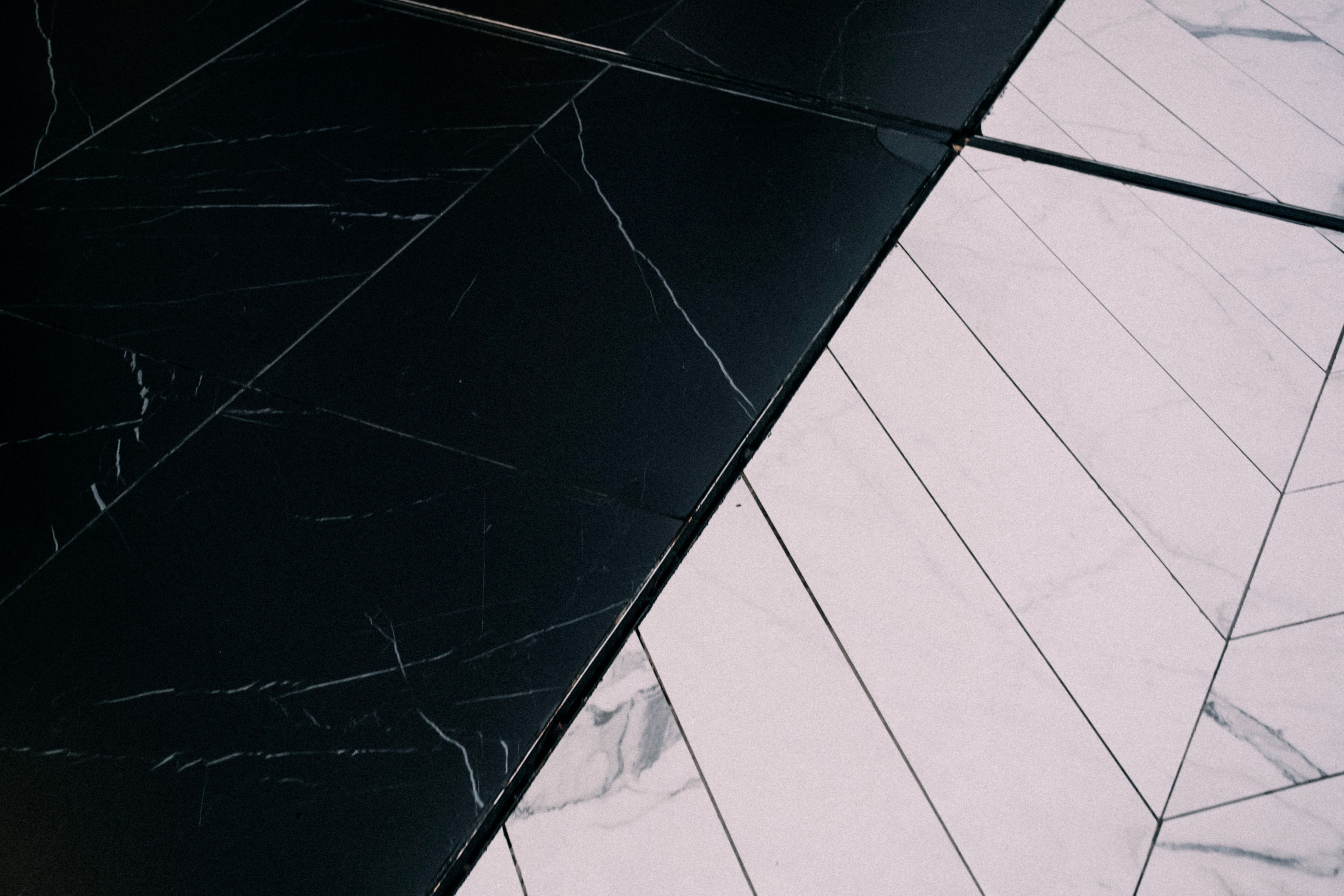
Is my worktop granite, marble or engineered stone?
Identify the stone first, because each reacts differently to cleaners. The handover file or the installer will tell you; on Vietnamese paperwork granite is “đá hoa cương”, marble is “đá cẩm thạch” and engineered stone is “đá nhân tạo”. Without documents, these features give a first indication.
| Stone | How to recognise it, and what that means |
|---|---|
| Marble | Soft, cloud-like veining, cool to the touch and fairly soft, about 3–4 on the Mohs hardness scale. It is mainly calcium carbonate, so it is very sensitive to acid, and it absorbs oil and scratches more easily than granite. |
| Natural granite | Speckled mineral grains in several colours; hard, about 6–7 on the Mohs scale, and heat-resistant. It is mostly silicate minerals and less affected by household acids, but it has fine pores and needs a sealer to keep oil and coloured liquids out. |
| Quartz-based engineered stone | Even colour and pattern, as in the ranges made by Vicostone or Caesarstone. Almost non-absorbent, but bound with polymer resin, which makes it sensitive to high heat and to some strong chemicals. |
| Acrylic solid surface | Continuous, with no visible joints, warm to the touch and can be curved. Softer than quartz, so it scratches more easily and dislikes heat. Follow the manufacturer's care instructions. |
How do I clean a stone worktop every day?
A neutral cleaner, clean water, then a dry cloth. The sequence is the same for every stone.
- Gather crumbs with a dry cloth or a small brush. Hard grains dragged across the stone scratch it.
- Add a few drops of mild washing-up liquid, or a pH-neutral stone cleaner, to warm water.
- Wipe with a well-wrung microfibre cloth, working in one direction, and go over the area around the hob twice if needed.
- Wipe again with a cloth dampened in clean water so that no soap is left, then dry the stone to prevent water marks and mineral deposits.
- Wipe up anything acidic at once: lemon juice, vinegar, soft drinks, wine, tomato sauce. On marble this matters most.
What etches, stains or damages each kind of stone?
Acid damages marble; strong solvents, strong alkalis and heat damage quartz. For natural stone, the care guidance of the Marble Institute of America, now the Natural Stone Institute, recommends a neutral cleaner, a soap made for stone or mild washing-up liquid in warm water. It warns that acids such as vinegar and lemon can dull and etch marble.
| Stone | Keep away from it |
|---|---|
| Marble | Vinegar, lemon juice, limescale remover, toilet cleaner, chlorine bleach, scouring powder, abrasive pads, and any glass cleaner or degreaser not marked as suitable for stone. |
| Granite | Strongly acidic or strongly alkaline cleaners used regularly, which can break down the sealer; scouring powder and steel wool. |
| Quartz-based engineered stone | Vicostone's care guide rules out acetone, paint stripper and other strong solvents. Caesarstone advises against highly alkaline cleaners such as oven and grill cleaners, and against setting hot pots and pans straight on the surface. |
| Every stone | Razor scrapers, and knives used directly on the surface. Use a chopping board and a trivet. |
How do I remove oil, coffee, wine and rust marks from a stone worktop?
First decide whether it is a stain or an etch. A stain is usually darker than the stone, because something has soaked in. An etch is a patch that has lost its polish: pale, flat, perhaps slightly rough. On quartz-based engineered stone most marks stay on the surface and come off with a neutral cleaner and a soft sponge.
On marble and granite a stain has usually soaked into the pores, and the remedy is a poultice: a paste of an absorbent material and a suitable liquid, laid over the stain to draw it out. Natural-stone industry guidance usually gives it 24–48 hours.
| Mark | What to do |
|---|---|
| Cooking oil and grease | Mix baking soda and water to a thick paste. Spread it about half a centimetre deep, overlapping the edge of the stain, cover with cling film, tape down the edges and leave for one to two days. Remove the film, let the paste dry out completely, lift it off with a plastic tool, wipe with clean water and dry. An old stain may need several rounds. |
| Coffee, tea or fruit juice on pale stone | A poultice made with low-strength hydrogen peroxide, and only after a test in a hidden corner: peroxide can lighten dark stone. |
| Wine, soft drinks, lemon juice, tomato sauce | These are acidic. Blot at once with kitchen paper without spreading the spill, wipe with clean water and dry. A pale, dull patch left on marble is an etch. |
| Water rings round the tap and sink on marble | No acidic limescale remover. Dry the area routinely, and ask a specialist once a ring has set hard. |
| Rust-coloured or yellow marks | Do not use a rust remover on natural stone yourself; most are acidic. Yellowing that comes from iron within the stone may only fade. |
| Dull marks from acid on marble | Surface damage, not dirt. Wiping and poultices do nothing for it; the patch needs honing and re-polishing. |
Does a stone worktop need sealing, and how do I test the sealer?
Marble and granite do; quartz does not. A sealer slows the rate at which natural stone takes up oil and coloured liquids, and it wears away with use. To test it, put a few drops of water on the areas that work hardest, beside the sink and around the hob. If the water still stands in beads after a few minutes, the sealer is working. If the stone under the drops has darkened, water is getting in and the worktop may need resealing.
A sealer has to match the type of stone and goes onto a surface that is clean and completely dry. On granite, cooking oil can soak in where the sealer has worn and leave a dark patch; the remedy is a deep clean followed by resealing.
How do I keep a worktop shiny without damaging it?
Dry it after cleaning, and keep wax and oil off it. Before any wet cleaning around the hob, switch the hob off and let it cool, and unplug the kettle, rice cooker or microwave nearby. Never mix cleaning products, wear gloves when using a degreaser or peroxide, and wipe the stone with clean water before food goes on it.
| Surface | What gives the shine |
|---|---|
| Polished marble and granite | The shine comes from the stone itself having been ground smooth, not from a wax. Drying with a microfibre cloth after cleaning already brightens it. Use a dedicated stone polish only as its instructions say. Stone that has turned dull or scratched needs professional honing. |
| Quartz-based engineered stone | The finish is made in the factory and needs no periodic polishing or sealing. A dull look is usually a film of soap or grease: wipe with a mild neutral degreaser and dry. |
| Never use | Cooking oil, candle wax, floor cleaner containing wax or toothpaste. They leave a film that holds dust, or fine scratches. |
When does a stone worktop need professional polishing, and what is done?
Call for it when marble carries many etch marks, when a deep stain has not faded after poultices, when the stone is scratched and has lost its shine, or when the sealer needs redoing. On a worktop or basin top the priority is deep cleaning and sealing; etch marks on marble are lightly honed and re-polished where they are. Only the steps the stone needs are carried out.
| Step | What it is for |
|---|---|
| Deep cleaning | Takes off residue and surface stains. Stone is sometimes dull only because it is dirty. |
| Honing | Diamond discs, from coarse to fine, remove the scratched or etched layer. It is done only where needed, because each pass takes away a thin layer of stone. |
| Polishing | Builds the shine back up on a clean or honed surface. It is the main step for granite. |
| Crystallisation | For calcium-based stone only: marble, and terrazzo with calcium-based chips. Granite is not crystallised; it is polished with dedicated materials and then sealed. |
| Sealing | Limits water, oil and coffee soaking in and staining. The sealer wears with use and has to be reapplied. |
What does stone polishing cost, and what can it not fix?
UpClean has no listed rate for stone worktops or stone floors, because the cost depends on how many steps the stone needs. The home survey is free. The written, all-inclusive quote sets out each step, the area and the working time, and does not change unless you agree in writing. Area, the type of stone (granite is hard and usually takes longer to hone), its condition, the finishing steps and access to the building all move the figure.
Before you decide, the specialist treats a small test area next to an untreated part, so that you see the result on your own stone; the same procedure gives different results on stones of different age and wear. Once you approve the patch, its shine is the standard for sign-off, and for 48 hours after you receive the Up Report, the photo record of the job, any area that falls short of it is treated again free of charge. The patch also shows the limits beforehand:
- A stain that has soaked in deep may only fade.
- Cracks, broken pieces and colour differences between pieces of stone may not be fully corrected by polishing.
- Engineered stone, travertine and limestone are assessed from close-up and wide photos before UpClean confirms whether it takes the job.
What UpClean does for stone worktops, and how to book a survey
The job runs in five steps. A survey identifies the stone and includes the test patch, and a plan with the written quote follows. Skirting, kitchen cabinets and nearby furniture are protected. The stone is honed wet to keep dust down, and the slurry is collected as it forms. Sign-off is in natural light, and the Up Report with before-and-after photos is sent by WhatsApp or Zalo. The machines make some noise, so the time is fitted to your household and to the building's rules on working hours.
To ask for a survey, send close-up and wide photos or a short video to 0968 726 135 on WhatsApp or Zalo, or call between 7:00 AM and 8:00 PM, seven days a week. Enquiries, the quote, the booking confirmation and the Up Report can be in English. If you would like a specialist who speaks English on site, say so when booking, and we tell you in advance if that cannot be arranged. Up specialists are identity-verified and trained to the Up Standard, and you receive the specialist's name and photo before the visit, which building management may ask for when outside staff have to be registered.
- Stone floor polishing
- The service for stone floors, stairs, worktops and basin tops.
- Deep cleaning
- The better fit when the whole kitchen needs cleaning: splashback, cupboards, appliances and sink.
- Book a survey
- Request a time for the survey and test patch.
- Contact UpClean
- Send photos or a video for a first assessment.
Frequently asked questions
Can I use vinegar on a marble worktop?+
No. Vinegar is acidic and can leave marble dull after a single contact. Use only a pH-neutral cleaner made for stone, or diluted mild washing-up liquid.
Is washing-up liquid safe on granite and marble?+
Yes, if it is mild and diluted: it suits daily wiping on most stone. Wipe again with clean water afterwards, because a soap film makes the surface look dull.
Can I put a hot pan on a quartz worktop?+
It can do harm. Vicostone and Caesarstone both advise against putting hot pots and pans straight onto quartz, because high heat can discolour and damage the surface. Use a trivet.
How often should a granite or marble worktop be sealed?+
There is no fixed interval for every stone. Do the water-drop test from time to time; when water darkens the stone within a few minutes, it is time to reseal.
Can I disinfect a stone worktop with bleach?+
Not on marble, and only sparingly on granite. Cleaning with a neutral product and drying is usually enough for a kitchen surface. On quartz, use only a disinfectant the stone's maker approves.
Can granite be crystallised like marble?+
No. Crystallisation is for calcium-based stone such as marble and terrazzo with calcium-based chips. Granite is polished with dedicated materials and then sealed.
Can an etch mark on marble be polished out?+
A dull mark left by lemon or vinegar is lightly honed and re-polished on the spot. How far it recovers is checked on the test patch first.
How much does it cost to polish a marble or granite worktop?+
There is no listed price. UpClean gives a written, all-inclusive quote after a free survey and a test patch.
Related guides
- Mould, damp and musty smells in Saigon apartments: causes and what works
- Sofa and mattress cleaning in a humid climate: how often, what you can do yourself, what it costs
- Pets at home in Saigon: how to remove urine odour and deal with fleas and ticks
- Why does my washing machine smell? How to clean it yourself, and when the drum has to come out
- How to clean a fabric sofa at home: the care label, stains by type, mould spots and when to book a deep clean
- Leather sofa cleaning and care: which leather you have, which cleaner to use and what never to put on it
- How to clean a mattress and topper at home: stains, odour, drying, and what to do with latex and memory foam
- How to clean curtains and blinds by type: what can go in the washing machine, how often, and how professional cleaning is priced
