
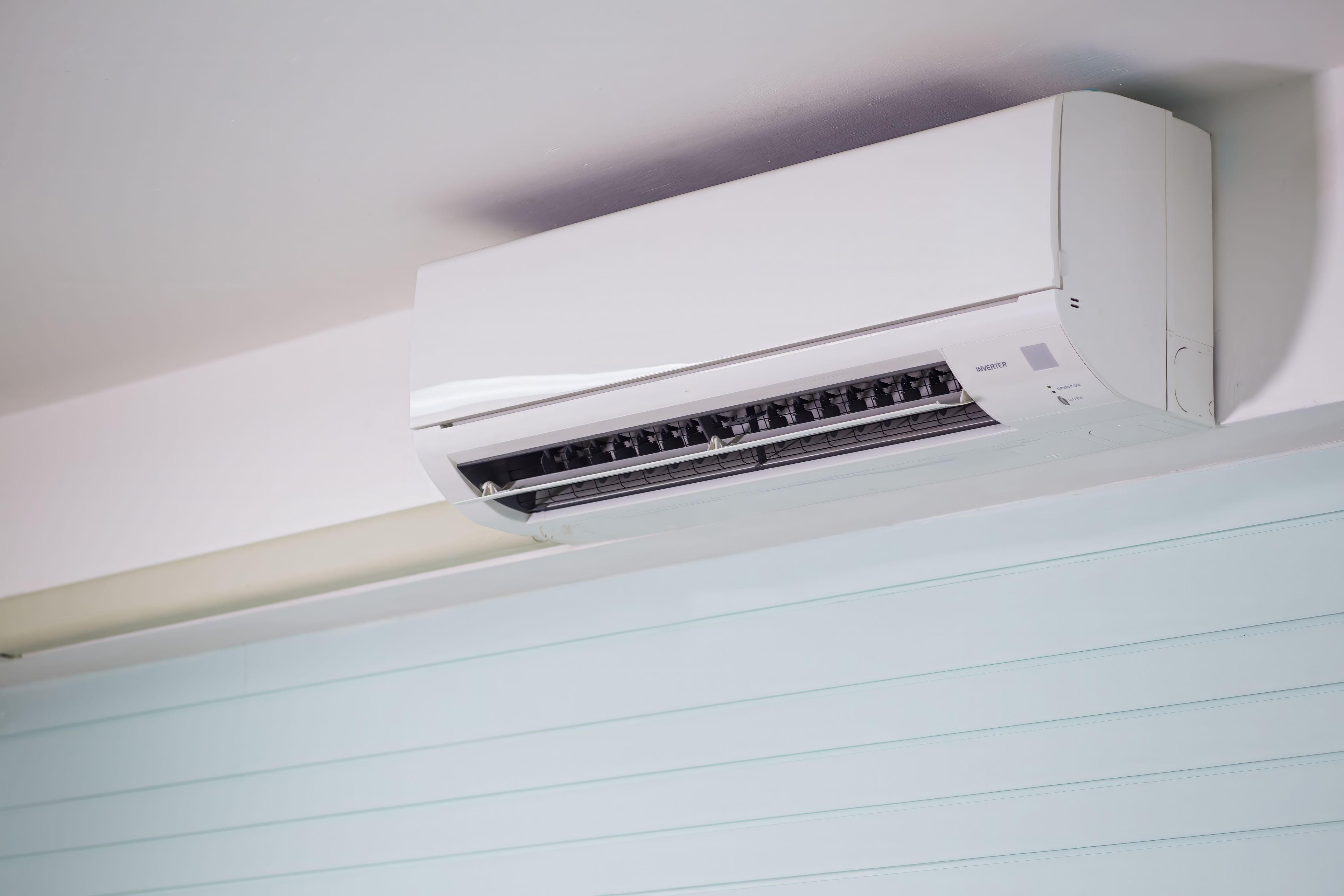
Which parts of an aircon can I clean myself, and which need a technician?
A careful owner can deal with the dust filter and the outer casing. Everything behind the filter means water close to electrical parts and belongs to a technician.
| Part | Who cleans it, and why |
|---|---|
| Dust filter | You. It comes out by hand as the manual shows, is rinsed in clean water and left to dry naturally. |
| Front panel and casing of the indoor unit | You, once the power is off: wipe with a soft cloth wrung almost dry. Do not push the louvre, the flap that directs the air, by hand; that can damage its drive. |
| Indoor coil (the aluminium fins behind the filter) | A technician. The fins are thin and dent easily. Dust between them has to be rinsed out at the correct pressure, with the control board and motors shielded; a hard object, a wire brush or a car pressure washer can damage them. |
| Blower wheel | A technician. This cylindrical fan sits far inside the indoor unit, usually under a dark, damp coat of dust, and needs proper tools and a water-collection bag. Do not try to take it out. |
| Drip tray and condensate drain hose | A technician. Sludge here is a frequent reason for a dripping indoor unit. The hose must be cleared without forcing a joint apart, so push no steel wire through it. |
| Outdoor unit | A technician, above all when it sits on a high-rise balcony, on a roof or in a service shaft. Never climb outside a railing or window to reach it. |
| Ceiling cassette unit | Only the filter, and only with a solid ladder, a helper and the manual. Its coil, drip tray and condensate pump, where fitted, are more complicated than a wall unit's. |
What should I do before I touch the unit?
- Turn the aircon off with the remote, then switch off the circuit breaker that supplies it. Wait a few minutes until the fan has come to a complete stop.
- Stand on a sturdy stepladder on a flat, dry floor, ideally with someone holding it, never on a swivel chair, a plastic stool or the edge of a bed.
- Spread a towel or plastic sheet below the unit to catch falling dust.
- Have ready a soft-bristled brush, a soft cloth, a basin of clean water and, for a greasy filter, some neutral washing-up liquid.
- Read the cleaning section of the manufacturer's manual: front panels and filters come out differently from one model line to the next.
How do I wash an aircon filter, step by step?
- Lift the front panel until it stays up by itself, without forcing the plastic catches.
- Draw the filter gently downwards and out, keeping your fingers away from the sharp aluminium fins behind it. Deodorising and fine-dust filters are removed separately, and many of them must not be washed in water; look them up in the manual.
- Remove the dry dust first, with a vacuum cleaner or a few light taps; water on a dusty filter makes mud that clings to the mesh.
- Rinse from the inner face of the filter towards the outer face, so that the water pushes the dust back out. A greasy filter can soak briefly in warm, not hot, water with a drop of neutral washing-up liquid, then be brushed lightly along the mesh.
- Shake off the water and leave the filter to dry naturally in a cool, airy place.
- Meanwhile, wipe the front panel and the casing with a soft cloth wrung thoroughly. No water goes inside the unit.
- Refit the filter the right way round, and only when it is fully dry. Close the panel, switch the breaker on, start the unit and check that the air flows freely.
What is the aircon cleaning bag sold online?
It is a waterproof, funnel-shaped cover that wraps round the indoor unit, catches the rinse water and sends it through a hose into a bucket. The coil and blower wheel can then be washed with the unit still on the wall, and the wall and floor stay dry. Without a bag, the unit has to come down or towels and plastic sheeting go underneath.
In Vietnam it is sold under several names, among them “túi vệ sinh máy lạnh” and “bạt vệ sinh máy lạnh”. They are the same thing.
| Part or type | What to know |
|---|---|
| Body of the bag | Coated waterproof fabric or flexible plastic, cut as a funnel. A drawstring, a hook-and-loop strip or hooks along the top edge hold it round the indoor unit. |
| Frame or stiffening strip | Found on some bags. It keeps the mouth open, so that the bag does not fold in against the fins under the spray. |
| Drain hose | A soft hose at the lower end takes the water to the bucket; a longer one makes a high-mounted unit easier. |
| Bags for wall-mounted units | Sized by the length of the indoor unit, which generally follows its capacity range. A wrong size gapes along the edge and lets water out. |
| Bags for ceiling cassettes | A square or round sheet that surrounds the face of the cassette and hangs from the ceiling on cords. Harder to fit, and it calls for a solid ladder. |
What can a cleaning bag not do, and should I use one myself?
The bag collects water and does nothing else. It does not keep water off the control board, the louvre motor or the wiring connectors, which have to be taken out or wrapped in waterproof material before any spraying begins. Where those parts sit varies between brands and model years, and finding and covering them is the hard part.
Daikin's operation manual warns against washing an air conditioner with water, since it can cause electric shock or fire, and adds that water on electrical parts can cause a malfunction. A technician cuts the power and covers the electrics before rinsing. Home attempts usually go wrong where those steps were skipped:
- Water reaches the control box, the louvre motor or a connector, and the unit shows a fault or short-circuits once the power returns.
- A bag of the wrong size, or one tied loosely, spills over its edge, down the wall and into a wooden floor, the curtains or the bed.
- The hose kinks and the bag fills. The weight drags the indoor unit out of line or off its mounting bracket.
- Pressure set too high, or a jet aimed across the fins, dents and flattens the aluminium.
- Strong chemicals of unknown composition, or several products mixed together, corrode the unit and leave an unpleasant smell.
- The power goes back on before the parts are dry, or the ladder shifts while both hands are busy.
| Your situation | What it points to |
|---|---|
| Doing it yourself may be reasonable | You have had the front panel off before and know where your unit's control board is. A second person is there, the ladder is solid, and the unit is a wall-mounted one at an easy working height. |
| Leave it to a technician | A ceiling cassette or a floor-standing unit. A recent inverter model with many sensors. A unit above the head of a bed, over a wooden floor or next to a built-in wardrobe. A unit still under warranty, or one whose front panel you have never opened. |
What should I look for if I still want to buy a cleaning bag?
- Measure the length and depth of the indoor unit before choosing a size; slightly too large is better than an exact fit.
- Choose a thick waterproof layer, tightly sewn seams, a stiffened mouth and a hose long enough for the bucket to stand firmly on the floor.
- Buy waterproof material to cover the control board as well. The bag does not do that for you.
- Check your aircon's manual. If its cleaning section covers washing the filter and nothing further, leave deeper rinsing to someone qualified.
How does a technician use the bag?
What keeps the work safe is the covering and the control of water before, during and after the rinse.
- Run the unit to note its condition, then cut the power at the breaker.
- Take off the front panel and the filters. Study how the unit is built, then remove, or seal in waterproof material, the control box, the louvre motor and the sensor tips.
- Fit the bag tightly round the indoor unit until no edge gapes, and lead the hose into a bucket standing on a floor already covered with towels.
- Rinse the coil and the blower wheel at moderate pressure, following the direction of the fins, and stop at once if water seeps from the rim of the bag.
- Rinse again until the water in the bucket runs clear, then check the drip tray and the condensate drain.
- Take the bag off, wipe the casing dry, let the parts drain, then reassemble, restore the power and test.
How often should I wash the filter, and when is a deep clean due?
On a unit in daily use the filter needs washing roughly once every two to four weeks (every two, according to many manufacturers' manuals). A technician's deep clean is due every three to four months for such a unit, and about every six months for one that is seldom on. Shorten both intervals with young children, elderly relatives or pets at home, or building work nearby. After a long idle spell, as in an apartment left empty or only just handed over, have the unit cleaned before it runs again.
Book sooner if the unit smells musty on starting, cools slowly, drips or makes an unusual noise.
- Aircon cleaning in Vietnam: how often, what is done, and what it costs
- Intervals room by room, and what each kind of unit costs to clean.
- Aircon leaking water, icing up or not cooling
- For a unit that has already started to misbehave.
What UpClean does on a deep clean, and how to book
On an UpClean visit the Up specialist, an identity-verified cleaner trained to our Up Standard, shields the control board, the wall and the furniture. A water-collection bag suited to the type of unit is fitted. The coil and blower wheel are rinsed at just enough pressure, the condensate drain is cleared, the unit is test-run and the gas pressure is measured. A wall-mounted unit of 1–1.5 HP (horsepower, its capacity rating) costs a fixed 250,000 VND, agreed beforehand. The Up Report follows by WhatsApp or Zalo, with before-and-after photos and any technical notes.
Everything from the first enquiry to the report can be handled in English. Before the visit you are sent the specialist's name and photo, which is also what a building's management office wants when it requires outside staff to be registered.
To book, phone or message 0968 726 135 (WhatsApp and Zalo on the same number), 7:00 AM to 8:00 PM, seven days a week, with the number and type of units and your building's name.
- Aircon cleaning service
- The scope of the clean and the areas we cover.
- Get a quote
- Pick the unit types and quantities and see the total.
- Book a visit
- Choose a day and a time; confirmation comes in writing.
Frequently asked questions
Does washing the filter myself replace a professional aircon clean?+
No. The filter holds back only the larger dust; fine dust and moisture pass through and build up on the coil, the blower wheel and the drip tray. A clean filter lets you go longer between deep cleans, and that is all.
Can I dry the aircon filter in the sun to save time?+
Better not. Harsh sunlight or heat can warp the plastic frame and mesh and make them brittle. Let the filter dry by itself somewhere cool and airy.
Does the cleaning bag stop the circuit board getting wet?+
No. It only catches the water that runs down. The control board, the motors and the wiring connectors have to be removed or covered separately with waterproof material before the rinse.
How long after rinsing with a cleaning bag can I switch the aircon back on?+
Wait until the parts have drained and dried and the casing has been wiped, then restore the power and test. If you suspect that water has got into the control board, leave the unit off and have a technician look at it.
Can I use a foam aircon cleaner spray together with a cleaning bag?+
You can, provided the foam is rinsed out thoroughly with clean water after the soaking time printed on the packaging. Otherwise the loosened dirt collects in the drip tray and blocks it.
Can one cleaning bag be used on several aircons?+
Yes, if the indoor units are of similar size. On a longer unit or one of a different shape the bag gapes and spills. Wash and dry the bag after every use so that it does not turn smelly or mouldy.
Related guides
- Cleaning the outside AC unit: why the outdoor unit needs it, what is safe to do yourself, and what a technician does
- Aircon freezing up: why ice forms on the indoor unit or the copper pipe, and what to do about it
- Ceiling cassette, ducted and floor-standing aircon cleaning: what is done, how long it takes and what it costs
- Sleeping with the aircon on all night: what temperature, which mode, and how to keep humidity in range
- Aircon cleaning in Vietnam: how often, what is done, and what it costs
- Aircon leaking water, icing up or not cooling: what to check before you call someone
