
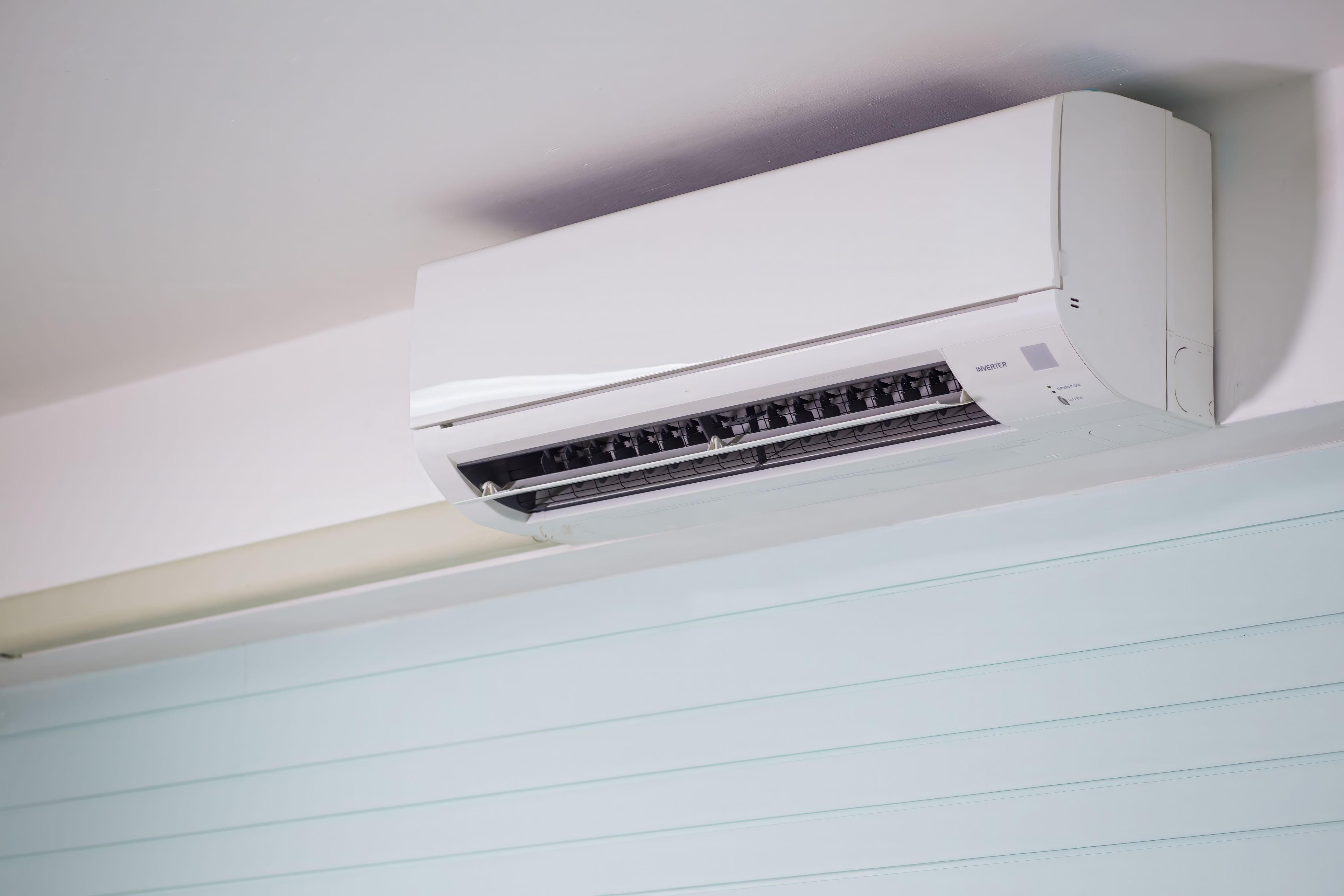
Symptom checker: likely cause, what to check, when to call
Find the row that matches what you see. A firm diagnosis still needs someone looking at the unit.
| Symptom | Likely cause, what to check, when to call |
|---|---|
| Steady drip from the lower front edge of the indoor unit | Likely a drip tray full of sludge or a blocked drain line. Check that the hose end outside is not kinked or sitting in water. Call for a deep clean; push nothing into the hose. |
| Water pours out a while after switching off | The coil probably iced up while running and is thawing. Check the filter. If it happens again with a clean filter, call for a deep clean and a gas-pressure reading. |
| Water runs down the wall behind the unit | A loose drain joint, an uninsulated copper pipe that sweats, or a unit that no longer slopes towards its drain. Stop and have it inspected; slope and insulation faults need a repair service. |
| Frost or ice on the coil or the outlet | Most often a dusty filter and coil; otherwise low gas, a weak indoor fan, or hours at the lowest temperature. Let it thaw, wash the filter and clear the airflow. Call if ice returns within days. |
| Frost on the thin copper pipe at the outdoor unit | Usually low gas pressure. Call to have it measured; gas that runs low again means a leak and a repair service. |
| Weak airflow | Usually dust on the filter, coil or blower wheel. Wash the filter; call for a deep clean if the airflow stays weak. |
| Strong airflow that is not cold | Check Cool mode, the set temperature and the remote batteries, then the outdoor fan. If that fan stands still, call a repair service; otherwise have the unit cleaned and the gas measured. |
| Cools at night, struggles at midday | Often an outdoor unit in direct sun, short of airflow or dirty, or a unit too small for the room. |
| Error code, or a compressor that never switches off | Possibly a sensor or the control board. Call the manufacturer's service centre. |
| Water dripping from the hose end outside | Normal while cooling. The warning sign is a dry hose end while the indoor unit drips. |
What should you do first when an aircon leaks or ices up?
- Turn the unit off at the remote so it stops making condensation.
- Put a towel or basin under the indoor unit, cover or move anything electrical below it, and dry the floor.
- Switch off the unit's circuit breaker before touching it, above all if water has run near a socket or cable.
- Let any ice melt by itself, which takes from tens of minutes to a few hours; Fan mode speeds it up. Chipping at it, a hair dryer or hot water can damage the thin fins, the control board and plastic parts.
- Once it has thawed, wash the filter, dry it fully and refit it. Restart at a moderate temperature with the fan on auto or medium, and watch the unit for a day or two.
Why does an aircon leak water or ice up?
Cooling condenses moisture from the room air on the indoor coil. The water drips into a tray under the coil and runs out through a drain hose, usually to the balcony. In a hot, humid climate there is a lot of it every day, so one obstruction sends water over the front of the unit or down the wall. In a unit long overdue for cleaning, the usual cause is a tray and hose clogged with fine dust and slime.
Ice forms when too little air passes over the coil, or the gas pressure is low: the coil's surface drops below 0°C and the moisture freezes instead of dripping away. The ice blocks the airflow, cooling gets worse, and the meltwater overwhelms the tray.
A newly installed unit that leaks has rarely had time to clog; ask the installer to check it under the installation warranty.
Why is the aircon running but not cooling?
Start with the settings; in many cases nothing is broken. The unit must be in Cool mode, usually a snowflake symbol; Dry mode mainly removes moisture and Fan mode only moves room-temperature air. An Eco mode limits output on some models, and weak remote batteries can leave the unit on an old setting. Close the windows and give a sun-baked room time to cool.
Next, with the breaker off, open the panel: a thick grey layer on the filter is choking the airflow. Then look at the outdoor unit from a safe place, never from outside the railing. Its fan must turn whenever the unit is cooling, and nothing should cover its fins or stand in front of it.
If all that is in order, compare the unit's capacity with the room. Daikin Vietnam's published rule of thumb is about 600 BTU of cooling per square metre, which gives these figures for ordinary conditions.
| Unit capacity | Room it suits |
|---|---|
| About 9,000 BTU (1 HP) | Under 15 m². |
| About 12,000 BTU (1.5 HP) | About 15–20 m². |
| About 18,000 BTU (2 HP) | About 20–30 m². |
| Rooms that need more | West-facing or top-floor rooms, high ceilings, large areas of glass, an open kitchen or many people. |
What should you not try yourself?
Water and electricity meet in the same place here, so leave these alone.
- Touching a wet indoor unit, socket or cable before the breaker is off.
- Blowing into the drain hose, using an air compressor on it, pushing wire into it or pouring strong cleaners down it. Pressure can pop a joint and send water into the wall.
- Spraying foam cleaner into the coil. The loosened dirt lands in the tray and often makes the leak worse.
- Adding gas. It takes a gauge, the gas type printed on the unit's label and safe handling at the valve, and R32 is mildly flammable.
- Loosening the brackets, adjusting the slope, opening the outdoor unit, or climbing outside a railing or window to reach it.
Does it need cleaning or a repair?
For most daily-use units more than three or four months past their last clean, a leak improves clearly once the coil and tray are cleaned and the drain cleared. Low gas looks the same as dirt from the outside, so clean first, then measure: refrigerant is not used up in normal running, and many weak units cool normally again once clean.
| What it needs | Typical situations |
|---|---|
| A deep clean | A tray full of sludge, a blocked drain line, icing from a dusty filter and coil, droplets thrown by a dirty blower wheel, outdoor fins coated in dust. |
| A measurement, then a decision | The unit is clean but still ices up or cools weakly: measure the gas pressure. If it is low, top up with the correct gas; if it runs low again, have the system checked for a leak. |
| A repair service | The wrong slope, a drain that runs uphill or has broken inside the wall, a cracked tray, uninsulated copper pipe, a refrigerant leak, a failed condensate pump on a ceiling cassette, an outdoor fan or compressor that does not run, error codes, a faulty sensor or control board. |
Is it all right to leave the aircon on all night?
Yes, if the unit is cleaned regularly, the temperature is moderate and the air does not blow straight at you. According to the Sleep Foundation, a bedroom that is too hot reduces the time spent in deep and REM sleep. In Ho Chi Minh City's climate, about 26–28°C with Sleep mode, a light blanket and a fan on low is a sensible starting point.
Aircons are designed to run for many hours. Dirt, an outdoor unit short of air, very low settings held for hours and frequent switching on and off wear a unit more than steady running at a moderate setting. The lowest temperature with the lowest fan speed in a small closed room is also the combination that invites ice.
What UpClean does for a leaking or weak aircon, and how to book
UpClean is a cleaning service. An Up specialist (an identity-verified, trained UpClean cleaner) covers the wall and furniture, cleans the filter, coil, blower wheel and drip tray, clears the drain, cleans the outdoor unit where it can be reached safely, and test-runs the unit to see that water drains evenly. The price is fixed: 250,000 VND for a wall-mounted unit of 1–1.5 HP. Gas pressure is measured free of charge on every clean; if it is low, you get a quote first, from 250,000 VND per unit for R32 or R410A on wall units up to 2 HP.
We do not repair: no adjusting brackets, replacing drip trays, fixing refrigerant leaks or changing parts. Signs of that kind go into the Up Report, the photo report sent by WhatsApp or Zalo after each visit, so you can take them to a repair service or the manufacturer's service centre. A leak caused by our cleaning falls under the 90-day warranty and is put right free of charge.
To book, call or message 0968 726 135 (phone, WhatsApp or Zalo) between 7:00 AM and 8:00 PM, seven days a week, in English if you prefer. A short video of the leak or ice, the number and type of units and your building's name are enough for a quote.
- Get a quote
- Choose unit types and quantities to see the price.
- Book a visit
- Choose a day and time. We confirm in writing and send a reminder the day before.
- Warranty Policy
- How to report a problem after a visit.
Frequently asked questions
Is a leaking aircon dangerous?+
The condensation itself is harmless. The risks are water near sockets and cables, a slippery floor and, over time, stained walls, mouldy ceilings and damaged wooden furniture. Switch it off at the breaker and deal with it early.
Will washing the filter stop the leak?+
It can, when the cause is ice from a very dirty filter. If the tray and drain line are clogged, it changes nothing: the sludge sits deep inside the indoor unit.
Why is my aircon leaking right after it was cleaned?+
Either loosened dirt was not fully flushed from the tray, or the drain joint was disturbed. With UpClean, a leak caused by the cleaning is covered by the 90-day warranty.
Does setting the lowest temperature cool the room faster?+
Not by much: the unit can only cool within its capacity. A very low setting uses more electricity and, with a dirty coil, raises the risk of ice.
Is a leak from a ceiling cassette different from a wall unit?+
A cassette usually relies on a condensate pump to lift water into the drain. Besides sludge, a failed pump or a stuck float can make it overflow and stain the ceiling; those parts need a repair service.
Should I set the aircon to switch off during the night?+
On cool nights an off-timer saves electricity. On hot, humid nights the room heats up again quickly and can wake you; running the unit through at a moderate temperature in Sleep mode is usually more comfortable.
