
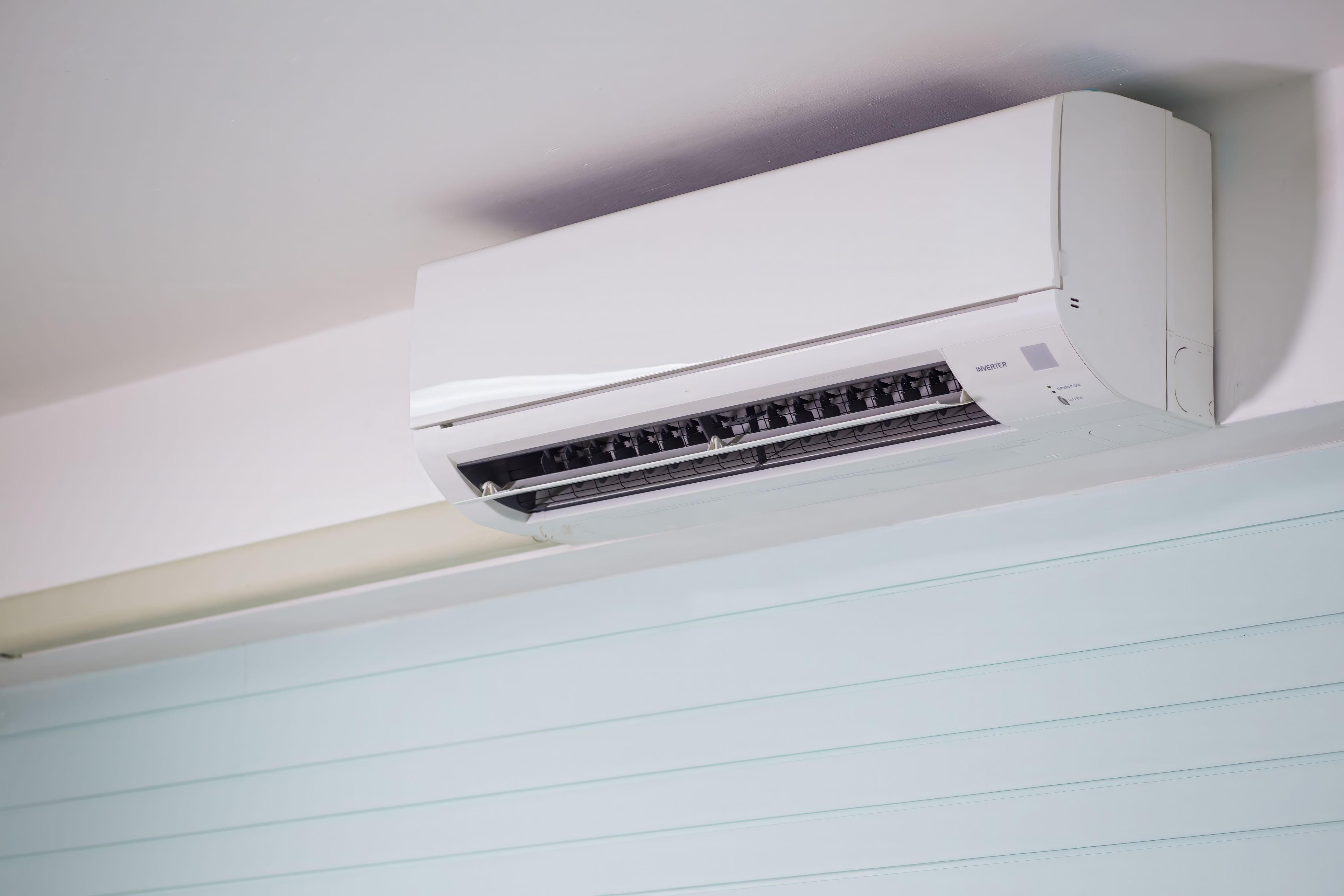
Why does ice form on an aircon?
Ice forms when the surface of the indoor coil falls below 0°C. In normal cooling the refrigerant gas evaporates inside the coil and absorbs heat from the air blown over it. The metal is then just cold enough for the moisture in that air to condense into droplets, which run into the drip tray and leave through the drain. This rests on a balance between the airflow, the quantity of gas and the temperature. Once that is lost, the water vapour freezes onto the coil as white frost, which thickens into ice.
The ice then closes the path of the air, so the unit cools still less, and when it melts the water can drip from the unit or spill down the wall.
| Where frost can appear | What to know |
|---|---|
| On the aluminium fins of the indoor coil | Visible once the front panel is lifted. |
| At the air outlet | Frost or ice showing in the opening where the cold air leaves. |
| On one corner of the indoor coil | Often seen when the unit is low on gas. |
| On the thin copper pipe or the service valve at the outdoor unit | Usually a sign of low gas pressure. Look only if the outdoor unit can be seen from inside the balcony. |
What causes an aircon to freeze up?
Daikin Vietnam's advice page names the common causes: maintenance neglected until dirt obstructs the airflow, low gas or a problem in the gas piping, a faulty fan, and an installation not done to standard. For apartments in Ho Chi Minh City they rank roughly as follows, most frequent first.
| Cause | How it produces ice, and what goes with it |
|---|---|
| Dust on the filter and the indoor coil | The most common cause. Dust cuts the air passing over the coil, too little heat is carried off, and the surface becomes too cold. Weak airflow and a damp smell usually accompany it. |
| Low gas | Low pressure lowers the temperature at which the gas evaporates. Frost tends to show on the thin copper pipe at the outdoor unit or on one corner of the indoor coil. The unit still blows, but the air is not cold. |
| A weak indoor fan | A blower wheel (the cylindrical fan inside the indoor unit) caked in dirt, a weakening fan motor, or the lowest fan speed held for a long time: each reduces the air crossing the coil. |
| A very low set temperature, run without a break | The lowest setting kept for many hours, above all in a small closed room and with little airflow, can take the coil below freezing point. |
| Temperature sensor or control board | A sensor that reads wrongly can keep the compressor running without cutting out. This usually calls for a repair service or the manufacturer's service centre. |
| Installation | A capacity that does not match the size of the room, a pipe run that is too long, or too little gas charged at installation. |
My aircon has ice on it. What should I do right now?
These steps are safe for an owner and limit the water that escapes while the ice melts.
- Stop cooling: switch the unit off with the remote. If it has a Fan mode, you can run that instead, since air at room temperature melts the ice sooner.
- Catch the water: put a thick towel or a basin directly under the indoor unit and cover the electronics, books and papers below it. Meltwater can arrive faster than the drip tray carries it away.
- Wait for the ice to melt. That takes from a few tens of minutes to a few hours, depending on its thickness. Do not prise it off with a knife, a screwdriver or anything hard: the fins are very thin and bend easily, and the tubing can be punctured.
- When no ice is left, switch off the unit's circuit breaker.
What should I check before switching it back to Cool?
Three things are within an owner's reach.
- The filter. With the breaker off, take it out, wash it, let it dry completely and refit it as the manufacturer's manual shows. A grey coat of dust on it is the likeliest explanation for the ice.
- The air path. Curtains, cupboards and furniture must not cover the openings through which the indoor unit draws air in and blows it out.
- The settings. Restart at a moderate temperature and not the lowest one, with the fan on auto or medium.
- Then watch the unit for a day or two, and note where the frost was and whether it returns.
What should I not do to a frozen aircon?
- Leave it cooling in the hope that the ice clears. The ice thickens, the compressor works harder, and more water spills when the unit is finally switched off.
- Aim a hair dryer or a fan heater at the coil, or pour hot water over it. That can wet the control board and deform plastic parts, and it is not electrically safe.
- Spray water or a cleaning product into the indoor unit while the control board and the fan motor are uncovered.
- Take off the casing or the blower wheel, or interfere with the pipework and the gas valves.
- Climb onto a railing or out of a window to inspect the outdoor unit of a high-rise apartment.
Is it dirt and poor airflow, or low gas?
The two look much alike, and an owner cannot settle the question by eye. The table is a first guide only. A reliable conclusion needs the unit cleaned first and the gas pressure then measured with a proper gauge.
| What you notice | What it points to |
|---|---|
| Filter covered in grey dust, weak airflow | Leans towards a dirty coil. In many cases the icing stops straight after a clean. |
| Clean filter, strong airflow, but no cold | Have the gas pressure and the state of the outdoor unit checked. |
| Frost on the thin copper pipe at the outdoor unit | Usually suggests low gas pressure. |
| Ice again within a few days although the filter was washed | The indoor coil and the blower wheel need a deep clean, and the gas pressure should be measured. |
| An error code, or a compressor that never cuts out | A sensor or the control board may be involved. Contact the manufacturer's service centre. |
When should I call someone?
Melting the ice and washing the filter treat the surface of the problem. If the cause lies deep in the indoor unit, in the quantity of gas or in a component, the ice will return. Call when:
- Ice forms again within a few days although the filter has been washed.
- A unit in daily use has gone more than three to four months without having its indoor coil cleaned.
- Frost or heavy condensation sits on the copper pipe or the valve at the outdoor unit.
- Water drips or runs down the wall even when there is no ice.
- The unit shows an error code, makes a strange noise, or its compressor runs without stopping.
What does a gas top-up cost, and when is it the right answer?
It is the right answer only once the unit has been cleaned and the pressure measured. UpClean measures the gas pressure free of charge at every aircon clean and writes the reading in the Up Report, the photo report you receive after the visit. If the reading is low, you are given a price before any gas is added, and nothing is topped up without your approval.
If the unit runs low on gas again later, a repair service should check the system for a leak.
| Item | UpClean's listed price |
|---|---|
| Deep clean, wall-mounted unit of 1–1.5 HP | 250,000 VND per unit, gas-pressure reading included. |
| Deep clean, wall-mounted unit of 2 HP or more | 300,000 VND per unit, gas-pressure reading included. |
| Gas top-up, R32 or R410A, units up to 2 HP | From 250,000 VND per unit, quoted before the work. |
| Top-up for a ceiling cassette, a floor-standing unit or another gas type | Quoted once the pressure has been measured. |
| Leak repair, sensors, fan motors and other parts | Not offered. These go to a repair service or the manufacturer's service centre. |
How do I stop the aircon icing up again?
Daikin Vietnam recommends cleaning the filter about once every two weeks and having the unit serviced at least once every six months. In the hot, humid climate of Ho Chi Minh City, where units run nearly every day, a deep clean every three to four months usually suits bedrooms and studies better.
- Wash the filter at regular intervals, and look at it more often if you live near construction or keep pets.
- Do not hold the lowest temperature for long stretches. Choose a moderate setting and add a ceiling fan or a standing fan if you need more.
- Avoid pairing the lowest fan speed with the lowest temperature in a small closed room.
- Keep the gas-pressure reading from every service, so that a falling trend shows early.
- When a unit is installed or moved, choose a capacity that suits the room's area and ask for the gas charge to be checked afterwards.
- Aircon leaking water, icing up or not cooling
- A symptom table for leaks and weak cooling.
- Aircon cleaning in Vietnam: how often, what is done, and what it costs
- Cleaning intervals by room and prices for several units.
What UpClean does for an aircon that keeps freezing, and how to book
An Up specialist, an identity-verified cleaner trained to the Up Standard, cleans the places where dirt is most often the root of icing: the filter, the indoor coil, the blower wheel, the drip tray and the outdoor unit. The gas pressure is measured afterwards. UpClean does not repair components or deal with gas leaks. Signs pointing to a sensor, a fan motor or a possible leak are written clearly in the Up Report so that you can take them to a repair service or the manufacturer's service centre.
Quotes, confirmations and the Up Report can be in English, and the report reaches you by WhatsApp or Zalo with before-and-after photos. The specialist's name and photo come ahead of the visit; pass them on if your building wants outside staff registered beforehand.
Message or call 0968 726 135 (phone, WhatsApp, Zalo) between 7:00 AM and 8:00 PM, every day. Tell us where you saw the frost, how many units you have and their type, and the name of your building.
- Aircon cleaning service
- Everything the clean covers, with the warranty terms.
- Get a quote
- Work out the price for your units online.
- Book a visit
- Request a day and a time slot.
Frequently asked questions
Is a frozen aircon dangerous?+
Not immediately, as a rule. But a unit left running with ice on it cools less, loads its compressor more heavily and tends to overflow when the ice melts. Stop the cooling and deal with it early.
How long does the ice on an aircon take to melt?+
Normally from a few tens of minutes to a few hours, depending on the thickness of the ice and the warmth of the room. Fan mode, if the unit has one, shortens the wait. Do not use heat to hurry it.
Does ice on the aircon always mean it is low on gas?+
No. A dirty filter and coil are a very common cause and look just like low gas. Low gas should be concluded only after the unit has been cleaned and the pressure measured with a proper gauge.
Will setting the aircon to 16°C make it freeze?+
Not by itself, if the unit is clean and has enough gas. Combined with a dirty filter, a low fan speed and many hours of continuous running, the risk rises. A moderate setting also uses less electricity.
Why is there ice on the copper pipe at the outdoor unit?+
Frost on the thin copper pipe or on the service valve outside usually suggests low gas pressure. Ask a specialist to measure it. If the gas keeps running low, a repair service needs to look for a leak.
I washed the filter and the aircon still ices up. What now?+
Dust has probably settled deep in the indoor coil and the blower wheel, or the unit is short of gas. It needs a deep clean and a gas-pressure reading. If ice still returns after that, ask a repair service to check the sensor and the fan.
The aircon froze and is now dripping water. Should I worry?+
Dripping while the ice melts is to be expected, because the meltwater can be more than the drip tray drains. If the unit goes on dripping once the ice has gone, the condensate drain may be blocked and needs cleaning.
Related guides
- Ceiling cassette, ducted and floor-standing aircon cleaning: what is done, how long it takes and what it costs
- Sleeping with the aircon on all night: what temperature, which mode, and how to keep humidity in range
- Aircon cleaning in Vietnam: how often, what is done, and what it costs
- Aircon leaking water, icing up or not cooling: what to check before you call someone
- How to clean an aircon yourself: AC filter cleaning step by step, the cleaning bag, and what to leave to a technician
- Cleaning the outside AC unit: why the outdoor unit needs it, what is safe to do yourself, and what a technician does
