
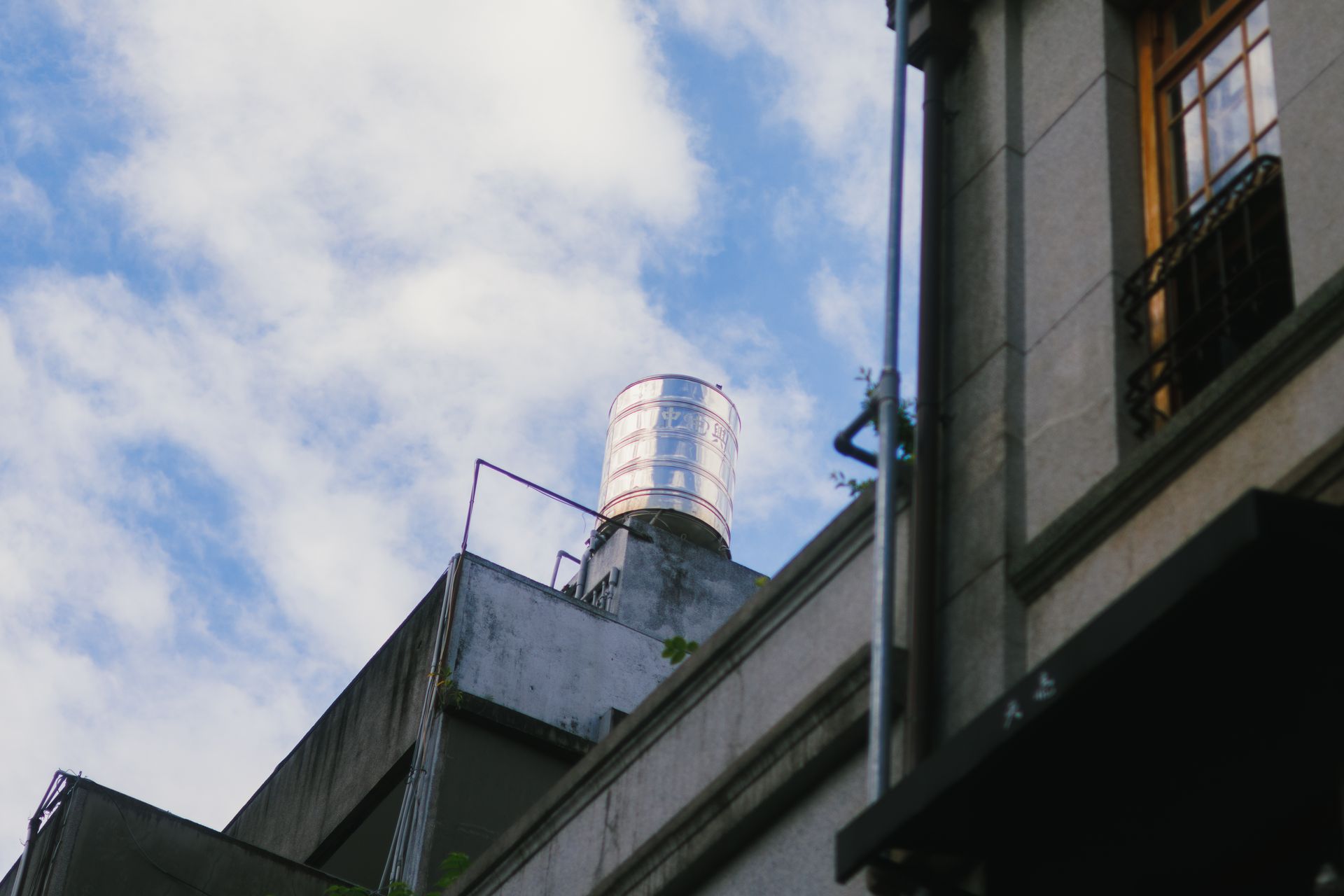
What do a rooftop tank and an underground cistern do in a Saigon house?
A villa or townhouse in Ho Chi Minh City may store its household water in a stainless-steel or plastic tank on the roof, or in an underground cistern (a storage tank built below ground). Many houses have both, or several tanks side by side. A pump fills the tank, and the water runs from it through the pipes to the showers, basins and filters in the house.
That is why what settles in the tank can end up at your taps. Silt, rust from the pipework, wind-blown dust and algae collect on the tank floor, in the corners, under the lid and around the float valve. In still water the layer stays down; each time the pump runs, part of it can lift and travel into the house.
Stainless steel, plastic or cistern: where does the dirt collect in each?
Each kind of tank gets dirty in its own places, so the tools and the scrubbing method change with it. The specialist identifies the type from the photos you send or at the survey.
| Type of tank | How it is built and where dirt settles |
|---|---|
| Stainless-steel tank, upright or horizontal | Fairly smooth inside, but sediment lodges on the floor and along the welded seams. Scrubbed with soft brushes and pads only: wire brushes and abrasive powders scratch the steel, and strong acid cleaners are not used. |
| Plastic tank | Algae can take hold faster when the tank stands in strong sun and the lid lets light through. The lid, its thread and any cracks from ageing are checked and recorded. |
| Underground cistern | Usually concrete, tiled or coated with waterproofing, holding a large volume behind one small access hatch. It needs a safety procedure of its own, set out below. |
| Unusual installations | A tank in a tall water tower, on a steep or tiled roof with no walkway, or a sealed cistern with several chambers. Assessed from photos and taken on only with a safe way to do the work. |
Which signs at the tap mean the tank needs cleaning?
The taps, the shower and the water filter show what is happening up on the roof. Read the signs together with the date of the last clean.
| What you notice | What it points to |
|---|---|
| Grit in a glass of water, or cloudy water | The deposit on the tank floor has grown thick and is churned up whenever the pump refills the tank. |
| A pale yellow tint in the water | As with grit or cloudiness, a reason to have the tank opened and cleaned. For yellow marks on the toilet bowl or shower glass, see our limescale guide. |
| An odd smell in the water itself | Possibly algae, organic sediment, or insects that got in under a lid that does not close. Clean the tank and check the lid and insect screen. If the smell comes from a drain rather than from the water, see our guide to bad smells at home. |
| Aerators, shower heads or filter cartridges clogging quickly | Sediment is travelling through the pipes to the fittings, which also wears out water-purifier cartridges faster. |
| Rainwater or dirty water got in, or the lid has gaps after the rainy season | Have the tank cleaned, then have the lid and seal looked at. |
How often should a household water tank be cleaned?
Every six to twelve months is the usual interval for a household tank. Where your house falls in that range depends on the water coming in, where the tank stands and how well its lid seals; watch for the signs above and book sooner when they appear. Some occasions call for a clean whatever the calendar says:
- After building work, renovation or new pipework, when cement dust, sand and metal filings can drop into the tank or arrive through the new pipes.
- Before moving into a newly built or rented house, or on returning after a long absence: water that has stood for weeks should be drained off first.
- After the rainy season, if the lid shows gaps or rainwater has found its way in.
- A newly built cistern before its first fill, to wash out cement dust, sand and bits of mortar so that less sediment travels through the pipes to the appliances. If it has just been coated with waterproofing, ask the builder how long to wait before filling it.
Why is cleaning a rooftop tank or cistern yourself risky?
A small plastic tank on a roof terrace with a railing is within a householder's reach: drain it, scrub it with soft tools and rinse it. A tank on a high roof, a large tank and above all an underground cistern carry the risk of a fall or the hazards of a confined space, and none of them is work for one person alone. UpClean's specialists work to these rules:
- Falls. Rooftop work goes ahead only with a fixed ladder, a roof deck with a railing or a solid platform. Near the roof edge a harness is anchored to a point that can take the load; with no suitable anchor point, a slippery way up, rain or strong wind, the visit is moved.
- The air in a cistern. The entrance is narrow, and the air inside may be short of oxygen or hold gases from decaying sediment. Open and ventilate it before anyone goes in, and keep a second person above the whole time.
- When not to go in at all: an unusual smell, poor ventilation, a hatch that is too narrow, or inflowing water that cannot be stopped.
- Power. Lighting inside a cistern needs a safe power supply, and the pump must be switched off so it cannot run while the tank is empty.
- Disinfectant. Only a product approved for domestic water storage, at the maker's dose, never mixed with another product, and rinsed out until no smell remains.
What does a proper water tank clean involve?
UpClean's specialists follow the same sequence on every tank and photograph each stage for the Up Report, the before-and-after record sent to you by WhatsApp or Zalo after the visit.
- Survey of location, access, capacity and sediment, from your photos or on a free visit.
- Pump switched off, supply valve closed and remaining water drained as agreed with you. A cistern is opened and ventilated first.
- Sediment sucked and scooped off the floor; walls, floor, corners and the inside of the lid scrubbed.
- Mechanical float valve or electric float switch, inlet and outlet pipes and any mesh screen cleaned.
- Disinfection with a product approved for domestic water storage, at the dose its maker specifies.
- Several rinses with clean water until the product can no longer be smelt, then the valve reopened and the taps checked for an even flow.
- Lid, seal and insect screen checked and any damage recorded, not repaired. Sediment taken away; roof, yard or pump room tidied.
How long will the house be without water, and how should you prepare?
The tank supply is off from the start of draining until scrubbing, disinfection and rinsing are done. The written quote states the expected duration and the size of the team, the specialist tells you the shut-off time beforehand, and the valve is reopened as soon as rinsing ends. A cistern needs extra time, because it is ventilated before anyone goes in and a second person stands watch above it.
- Store water for the shut-off in covered containers: the Pasteur Institute in Ho Chi Minh City advises keeping water containers tightly covered, as mosquitoes breed in standing water.
- If the house has several tanks, or a rooftop tank and a cistern, have them done on the same day: one shut-off instead of several.
- Rooftop and cistern work is scheduled in daylight where possible. Rain, strong wind or a slippery roof moves the visit, and UpClean contacts you to agree a new time.
- You need not be at home. A key can be left with family, reception or building management, only the assigned specialist handles it, and the walk-through can be done by video call.
Does a tank clean include a water test or repairs?
Cleaning and testing are separate jobs. A clean removes what has settled in the tank and disinfects its surfaces; it is not a water test, and UpClean makes no commitment about any measure of water quality. If you want the water tested, contact a laboratory authorised to do it once the tank has been cleaned.
Nor does a clean fix the parts around the tank. UpClean cleans the float, pipe ends and lid and records any fault in the Up Report, but does not repair or replace pumps, valves or floats. Pass those notes to your plumber.
What does water tank cleaning cost with UpClean?
Tanks are priced per tank by capacity and cisterns by volume. The price is all-inclusive, covers the whole sequence above including the Up Report, and is confirmed in writing before the visit. Send photos and the specialist confirms which rate applies; a cistern or a difficult location is surveyed at the house free of charge.
The rate and the time needed depend on the type and capacity of each tank, how many there are, how easy they are to reach, how thick the sediment is, and any work added to the same booking, such as the roof area, the pump room or a post-construction clean. Nothing is added on the day without your written approval.
| Tank | Fixed price |
|---|---|
| Tank up to 1,000 litres | 450,000 VND |
| Tank over 1,000 up to 2,000 litres | 650,000 VND |
| Tank over 2,000 up to 5,000 litres | 850,000 VND |
| Underground cistern | 70,000 VND per m³, with a minimum of 1,500,000 VND |
| Tank over 5,000 litres | Quoted after a survey. |
| Minimum per visit | 450,000 VND |
What does UpClean do for a water tank, and how do you book?
Send photos of each tank and the way up to it, or of the cistern hatch, to 0968 726 135 by phone, WhatsApp or Zalo, from 7:00 AM to 8:00 PM daily. Quotes, confirmations and the Up Report can be in English. If you want an English-speaking specialist at the house, say so when booking; if that cannot be arranged, you are told in advance and supported by phone or message.
Before the visit you receive the specialist's name, photo and contact number, which is what building management needs if it asks residents to register outside staff. Up specialists are identity-verified and trained to the Up Standard, UpClean's working standard. You pay after the walk-through, by bank transfer or cash. If anything within the agreed scope is not right, reply to the Up Report and it is redone free of charge within the period in the Warranty Policy, 48 hours by default.
- Water tank cleaning
- What is included for each type of tank.
- Price list
- Every listed price in one place.
- Get a quote
- Price the work online.
- Book a visit
- Choose a day and time.
- Moving into a new home
- What else to clean before you unpack.
- Mosquitoes in the rainy season
- A weekly round of standing water, tanks included.
- Limescale and yellow stains in the bathroom
- Marks on glass, taps and the toilet.
- Bad smells at home and in the bathroom
- Smells from drains and wastes.
Frequently asked questions
How often should I clean my water tank?+
Every six to twelve months for a household tank, and sooner if the water carries grit or smells odd, after renovation or new pipework, or when the house has stood empty for a while.
Can I clean my rooftop water tank myself?+
A small plastic tank on a roof terrace with a railing, yes. A tank on a high roof, a large tank or an underground cistern should not be cleaned by one person alone, because of the risk of falling and the hazards of a confined space.
Is it dangerous to go inside an underground water tank?+
It can be. The air in a cistern may be short of oxygen or hold gases from decaying sediment, so it is ventilated first and someone stays above throughout. UpClean always works in cisterns as a team of at least two.
Will disinfectant end up in my tap water?+
UpClean uses products approved for domestic water storage at the maker's dose, rinses the tank several times until no smell of the product remains, and only then restores the supply.
Do you test the water after cleaning the tank?+
No. UpClean cleans and disinfects the tank but does not test the water or commit to any measure of its quality. For testing, contact an authorised laboratory after the clean.
Can a stainless-steel tank get scratched during cleaning?+
Only soft brushes and pads are used, with no wire brushes, abrasive powders or strong acid cleaners, to avoid scratching the steel.
Can you fix a float valve or a lid that does not close?+
UpClean cleans these parts and records any fault in the Up Report, but does not repair or replace water-supply equipment. Pass the report to your plumber.
Related guides
- Villa and townhouse cleaning in Ho Chi Minh City, floor by floor: scope, time, price and upkeep
- How to get rid of old furniture in Ho Chi Minh City: selling, giving away, junk removal and clearing a storeroom before you move
- Musty smell and mould in a car in Saigon: where the damp comes from, how to clean the seats, and when it needs a garage
- Leaving your Saigon apartment empty: how to limit mould, smells and pests while you are away, and what to check when you return
- How much does a cleaning service cost in Ho Chi Minh City in 2026?
- Hiring a house cleaner or maid in Ho Chi Minh City: a practical guide for expats
- Move-out cleaning in Ho Chi Minh City: a checklist for handing back a rented apartment
- Moving into an apartment in Saigon: what to clean before you unpack
