
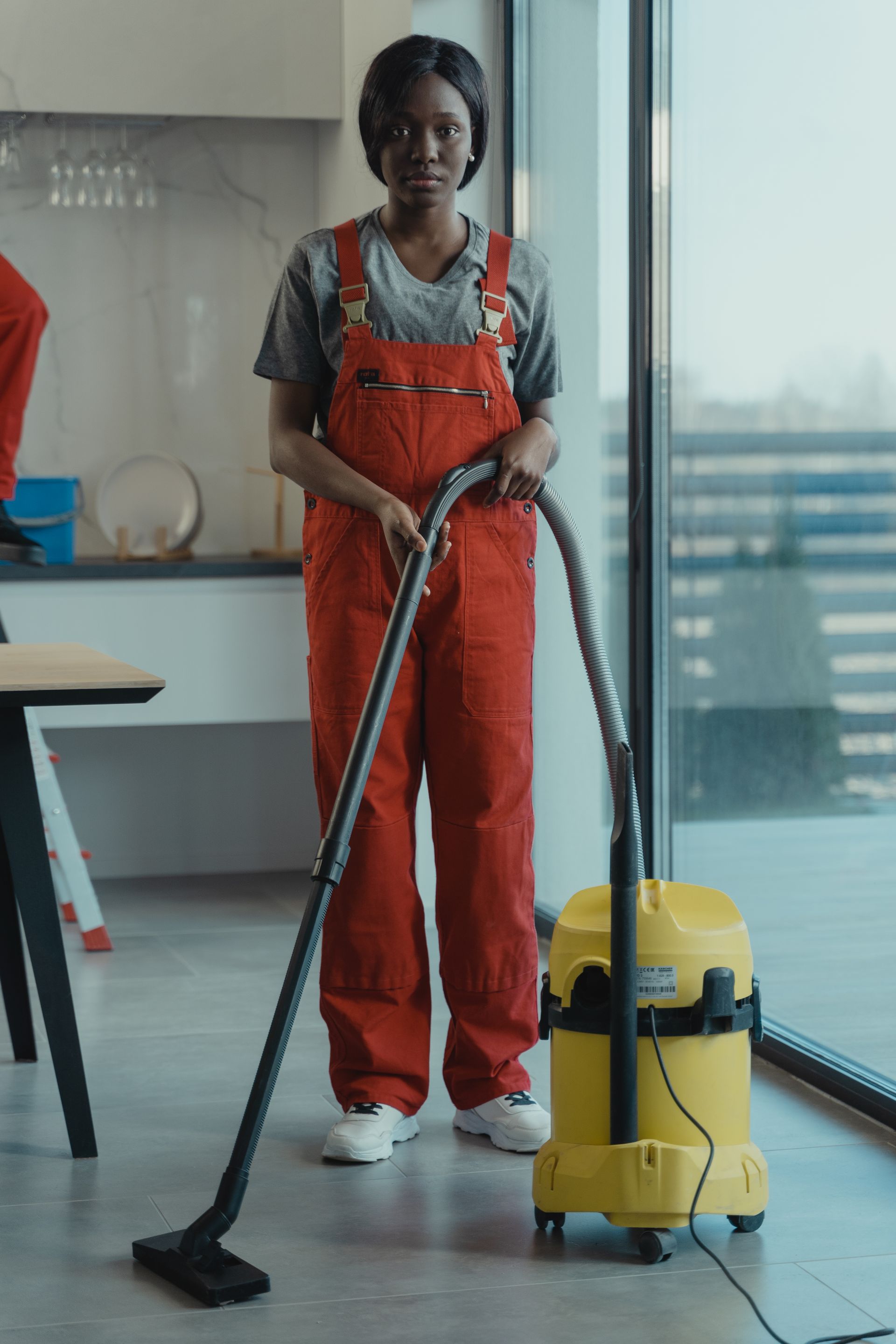
What does “industrial cleaning” mean in Vietnam, and how is it different from a deep clean?
The Vietnamese term describes how the work is done, not where: a newly handed-over flat can need it as much as a warehouse. It means a team in which one person coordinates and checks; floor scrubbers and vacuums that take up dirty water as well as dust; a checklist for every area, from ceilings and vents through glass, kitchen and washrooms down to floors and grout; and a sign-off against that list. Work runs from high to low and from the furthest room towards the door, so falling dust lands only on what is still to be done.
The four labels below are often used as if they meant one job; the table separates them.
| Service | What it is, and when it fits |
|---|---|
| Deep clean | One thorough clean of a lived-in home, often priced per m². Usually enough for a furnished flat of moderate size. |
| Industrial cleaning | A team with machines covers the whole property against a checklist. Suits large areas, business premises and properties empty or changing hands; quoted per site after a survey. |
| Post-construction cleaning | The branch for premises just built or renovated: fine dust vacuumed in several passes, paint, cement and adhesive removed before wet cleaning. |
| Janitorial staff | People on site for a shift or set hours to keep premises tidy through the day, on a monthly contract. |
When does a shop, showroom, restaurant, clinic or new building need one?
Book after the last job that raises dust, and before anything dust would spoil is brought in.
| Premises | When to book, and what to watch |
|---|---|
| Shop or showroom before opening | Pre-opening cleaning goes between the contractor's last job and the delivery of stock. Fit-out dust settles inside display cases and on lights, and glue, paint and tape stay on glass and floors. Shelves are wiped again just before goods go out. |
| Shop or showroom already trading | After a display change, before a launch, ahead of year-end and Tết. Routine work finishes before opening; anything that must dry goes to a closed day. |
| Shophouse with living floors above | One job, worked from the top floor down, with separate checklists for the home and the shop. |
| Restaurant, café or small hotel | Kitchen deep clean, extraction hoods within safe reach, dining area, upholstered chairs and washrooms, per job or monthly. |
| Clinic, school or gym | Waiting rooms, classrooms, touch points, showers and changing rooms; in a clinic UpClean cleans non-clinical areas only. |
| New or renovated house or villa | When drilling, cutting and painting have stopped and debris has gone, before sofas, mattresses and curtains arrive; new grout and adhesive dry for the time their maker recommends. If handover cannot wait for the last works, split it: a rough clean now, a finishing clean before moving in. |
How is industrial cleaning priced: per m², by the hour or as a package?
UpClean prices industrial cleaning as one all-inclusive figure per site, not by the hour. Hourly help at home is Up Home, at 130,000 VND per hour for one specialist, minimum 3 hours; businesses wanting cleaners at fixed hours use janitorial staffing.
| Model | How it works, and where it fits |
|---|---|
| Per m² of floor | Area times a rate, with a minimum per visit. Fair for homes of one type, which are built much alike; a poor guide for shops and offices, where glass, floor material, washrooms and permitted hours vary at the same size. |
| By the hour | People times hours times a rate. You direct the work, but the total is known only at the end unless hours are capped; ask whether machines and products are included. Fits small, repeated upkeep. |
| Package per site | One price for an agreed checklist, set after a survey. The provider chooses team, equipment and duration, and the work is accepted item by item; extras need a supplementary quote. Fits deep cleans and handovers. |
How do you read the quote, and which items have a listed price?
Compare scope before totals, since most price gaps are scope gaps. If one quote is far below the rest, ask whether anyone saw the site, even by photo, and whether paint, cement residue and high glass are included. A usable quote states:
- the items by area, and what is excluded, such as outside glass, cabinet interiors or aircon;
- the unit (m² of floor or of glass) and the minimum charge per visit;
- the number of people, the equipment and the expected duration;
- who may approve an extra charge, and how;
- the acceptance criteria, when you pay, and whether a VAT invoice is issued.
| Item | UpClean's listed price |
|---|---|
| Deep clean of a lived-in home | Apartment 15,000 VND, townhouse 17,000 VND, villa 20,000 VND per m² of floor; minimum 900,000 VND per visit. |
| Post-construction or move-in clean | Apartment 22,500 VND, townhouse 25,500 VND, villa 30,000 VND per m² of floor; minimum 1,350,000 VND per visit. |
| Machine floor scrubbing | 12,000 VND per m² for apartments and offices; 15,000 VND per m² for townhouses, villas and showrooms; minimum 900,000 VND per visit. |
| Interior glass within safe reach | 10,000 VND per m² of glass; minimum 500,000 VND per visit. |
| Full job for business premises | No rate per m²: a written all-inclusive quote after a free survey. |
Which safety points matter: cleaning products, height and glass façades?
Most damage to surfaces comes from a product that suits the dirt but not the material; the label and the material maker's advice come first. Never mix cleaners: chlorine bleach meeting an acid or ammonia can release toxic gas. Ventilate washrooms and windowless rooms during the work.
- Height, as UpClean works: ceilings, lights, vents and glass, the outside of glass included, are cleaned where they can be reached safely from a balcony, a terrace or a proper ladder. A position that needs work-at-height equipment is a separate quote item, done only if you approve it; façade glass that needs rope access or a gondola is outside UpClean's scope. Ask any company which high positions it will clean, and with what.
- Wet floors: warning signs at each way in, and a dry route kept open, above all on polished stone.
- Children and pets: in another room while machines run, back once floors are dry and rooms aired.
| Material | Use, and avoid |
|---|---|
| Marble, limestone, terrazzo | A neutral cleaner, then dry. No acidic product, vinegar or lemon, which can leave the stone dull and pitted. |
| Timber floors | A well-wrung cloth. No poured water and no wet machine scrubbing. |
| Glass | Wet it before any scraping; no blade on filmed glass. |
| Stainless steel and aluminium | A mild product wiped along the grain. No chlorine or metal scourer. |
| A material you cannot identify | Test a hidden spot and judge it once dry; engineered and natural stone are easily confused. |
How should the work be checked before you sign it off?
Acceptance criteria are agreed by the two sides in the quote or contract, not set by a government regulation. Each should be checkable by eye or hand (“no streaks seen at an angle”, not “sparkling”), tied to a place on the checklist, and clear about what cleaning cannot change, such as scratches. Walk the site in daylight or with every light on, in the order the team worked, mark each line pass or fail and photograph each failure.
| Area | Passes when |
|---|---|
| Glass and mirrors | No streaks or fingerprints seen head-on or at an angle. |
| Sliding tracks and frames | No sand in the track; the door runs without grating. |
| Floors | Dry at corners and skirting; no machine marks or film; no new scratch against the before photos. |
| Kitchen | Not greasy to the touch; food-contact surfaces wiped again with clean water. |
| Washrooms | No limescale or soap scum at the agreed points; drains clear. |
| Cabinet tops and door frames | A dry cloth comes away clean. |
What should the acceptance record contain, and what if an item fails?
The acceptance record (“biên bản nghiệm thu” on a Vietnamese form) states how far the work is complete, and companies usually file it with the invoice. What follows is common practice, not a legal template.
Dirt left inside the agreed scope is redone on the spot, or given a deadline, at no charge. A mark that stays because the material is damaged is recorded with a photo as a limit of cleaning. Work outside the scope is not a failure; it needs a supplementary quote. On a new building, the cleaner's photo report helps with the builder but does not replace the technical handover record you sign with the contractor.
| Part of the record | What to write |
|---|---|
| Header | Both parties, the site address, the quote or contract number, the date. |
| People | The provider's person in charge and your authorised person. |
| Result | Items by area, pass or fail, with the location of each failure. |
| Outstanding work | What is redone, by whom and by when. |
| Existing condition | Earlier marks, material damage, areas not reached. |
| Premises | Furniture back, keys returned, rubbish removed. |
| Photos and confirmation | Before-and-after photos or a reference to the photo report; both signatures. |
How do you judge a cleaning company before you sign?
Compare companies on what each will commit to in writing. Whichever industrial cleaning companies you shortlist, score each one, UpClean included, on the eight points below: 2 if answered in writing, 1 if only spoken, 0 if not, out of 16. Be wary of a large job priced by phone with nothing asked about condition, materials or glass, a single total with no item list, or a dodged question about damage. Contract clauses are covered in our office cleaning guide.
- A written quote by area, with the conditions for any extra charge.
- A named person in charge on site, with a phone number.
- An acceptance checklist sent with the quote.
- Before photos, taken and sent to you.
- A stated method for each material on your site.
- A contract and a VAT invoice, with the issuing company named.
- A written damage procedure: deadline, photo comparison, remedy.
- Payment after sign-off, with any deposit stated.
What UpClean does for industrial cleaning, and how to book
UpClean takes on industrial cleaning in Ho Chi Minh City for homes, offices, shophouses, showrooms, building common areas, restaurants, schools, clinics (non-clinical areas) and gyms, and after building work; factories and warehouses after an on-site survey, with hazardous-chemical handling excluded.
The survey is free, on site or from photos sent by WhatsApp or Zalo, and the written quote is the final price unless you approve an addition in writing. Up specialists are identity-verified and trained to the Up Standard, our working standard. A team lead records the premises as found, checks each area as it is finished and walks through with you. The Up Report, our before-and-after photo record, follows; any item below standard is redone free within 48 hours of it. Payment follows sign-off, with a VAT invoice on request.
Quotes and reports can be in English; if you need an English-speaking specialist, say so when booking, and if we cannot arrange one we tell you in advance. Names and photos of the team come beforehand for building registration. Call or message 0968 726 135 (phone, WhatsApp, Zalo), 7:00 AM to 8:00 PM daily.
- Request a survey
- Send the address and a preferred date.
- Office cleaning: scope and contract
- Daily cleaning, janitorial staff and the clauses an office contract needs.
- After a renovation
- Paint smell, cement haze and which tiles can take a cement remover.
- Cleaning costs in Ho Chi Minh City
- Worked examples for homes.
Frequently asked questions
What is the difference between industrial cleaning and deep cleaning?+
A deep clean is one thorough clean of a lived-in home. Industrial cleaning brings a larger team and machines, for large or empty properties, homes about to be moved into and business premises. Area and condition decide which fits.
Is industrial cleaning only for factories?+
No. In Vietnam the term describes the method and the scale, not the building. Offices, apartment blocks, showrooms, finished building sites, apartments and villas can all need it.
Do industrial cleaning companies charge per square metre?+
Some do. UpClean lists per-m² rates for homes, 15,000 VND for a lived-in apartment and 22,500 VND after building work, but prices business premises after a free survey, because glass, materials, dirt and timing drive the workload more than floor area.
How long does an industrial clean take?+
The quote states it. An apartment is usually finished within the day, or in one to two days when it is new and full of building dust. Villas and large premises may be split over several consecutive sessions.
Will display stock be moved during a showroom clean?+
At UpClean, only with your permission. Positions are photographed first and everything goes back where the photo shows. Products are only dusted with a dry, fine cloth unless you approve another method.
Does a stain that will not come out count as a failed item?+
Not when the material itself is damaged, as with etched marble or grout discoloured over years. Such marks should be pointed out at the survey and entered in the acceptance record as a limit of cleaning, with a photo.
